Discover why a strong developer portfolio attracts 9x more clients than a CV alone, what to include, how to design it for results, and how to keep improving it.
Why a great developer portfolio brings clients to your door
TL;DR:
- A developer portfolio is the primary proof of capability and persuades clients effectively.
- Structure projects around problems solved, results achieved, and trust signals to attract clients.
- Regularly optimize your portfolio for clarity, trust, and engagement to increase inquiries.
Freelancers with portfolios are hired up to 9x more often than those without one. That single figure should stop any developer in their tracks. Yet the assumption persists that a polished CV, a few LinkedIn recommendations, and word of mouth are enough to win consistent work. They rarely are, especially when clients and hiring managers are comparing you against developers who can show, not just tell. This guide covers why a developer portfolio is now a non-negotiable business tool, what it must contain, how to design it for real results, and how to keep refining it so it continues to bring the right people to your door.
Table of Contents
- Why portfolios outshine CVs for developers
- What an effective developer portfolio includes
- Designing your portfolio for results: UX, speed, and trust
- Optimising and evolving your portfolio
- The uncomfortable truth: portfolios are sales tools, not just showcases
- Ready to stand out? Build a portfolio that works as hard as you do
- Frequently asked questions
Key Takeaways
| Point | Details |
|---|---|
| Portfolios drive results | Developers with great portfolios get more interviews and clients than those with just CVs. |
| Showcase impact, not just skills | Portfolio projects should emphasise business outcomes and relevance over sheer volume. |
| Optimise for UX and trust | Fast, mobile-friendly sites with clear CTAs and testimonials convert more clients. |
| Keep evolving | Continuous updates and honest case studies keep your portfolio competitive. |
Why portfolios outshine CVs for developers
A CV tells a prospective client what you claim to have done. A portfolio shows them exactly what you built, how you approached it, and what the outcome was. For most businesses commissioning development work, that difference is enormous. They are not hiring a qualification; they are hiring a problem solver. Proof of past problems solved is far more persuasive than a list of job titles.
The numbers back this up clearly. 73% of hiring managers consider a strong portfolio more important than a perfect resume for developer roles. That is not a marginal preference; it is a decisive majority. When a client shortlists two developers with similar experience on paper, the one with a well-presented portfolio almost always wins the conversation.
“A portfolio is not a supplement to your CV. For developers, it is the primary evidence of your capability.”
The freelance market has accelerated this shift. The number of independent developers and contractors has grown sharply, meaning clients now have more choice than ever. In that environment, freelancers with portfolios are hired up to 9x more often, which makes a portfolio less of a nice addition and more of a basic requirement for competing.
What do businesses actually look for first? Most will scan for:
- Relevant project types that match their own industry or problem
- Measurable outcomes, such as faster load times, increased conversions, or reduced costs
- Clear communication of what you did and why
- Trust signals like testimonials, recognisable clients, or live links
| Factor | CV | Portfolio |
|---|---|---|
| Demonstrates real output | No | Yes |
| Shows problem-solving approach | Rarely | Always |
| Builds immediate trust | Low | High |
| Differentiates from competitors | Difficult | Straightforward |
| Supports client decision-making | Weakly | Directly |
A CV is a document built for filtering. A portfolio is a tool built for persuasion. If your goal is to attract clients or land contracts, you need the latter.
What an effective developer portfolio includes
Knowing you need a portfolio is one thing. Knowing what to put in it is another entirely. Many developers make the mistake of treating their portfolio as an archive, stuffing in every project they have ever touched. That approach backfires. Clients do not want volume; they want confidence.
78% of hiring managers say a well-structured portfolio is the single most important factor when evaluating freelancers. Structure matters as much as content. The ideal portfolio format is 3 to 5 high-quality projects, each presented with the problem, the solution, and measurable results.
Here is a practical structure to follow:
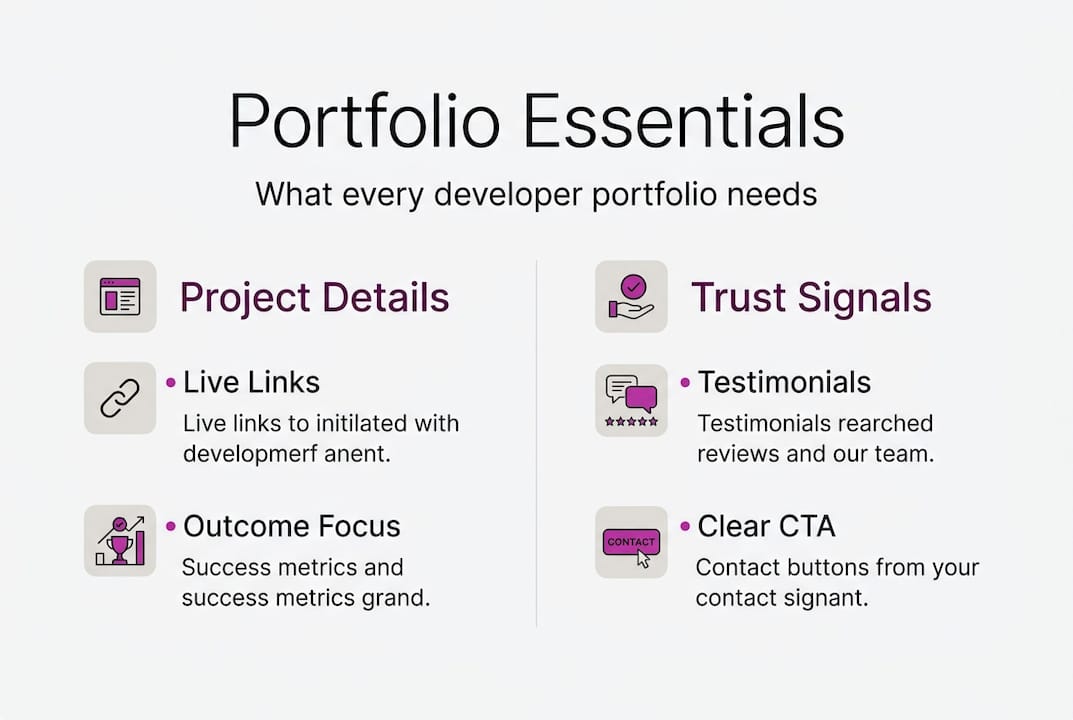
- Hero section with a clear value proposition — who you are, what you do, and who you do it for, in two sentences
- Curated project samples — three to five projects, each chosen because they reflect the work you want more of
- Case study stories — for each project, explain the brief, your approach, the technology used, and the outcome with real numbers
- Testimonials and trust signals — client quotes, recognisable brand logos, or links to live work
- A direct call to action — make it obvious how to contact you or book a call
For a practical example of how a B2B project can be presented with context and outcomes, the B2B connections project on richharrington.dev illustrates this well. Similarly, the approach taken in custom SaaS work shows how to frame technical capability around business value rather than tech stacks alone.
| Portfolio element | Why it matters |
|---|---|
| Value proposition | Tells clients instantly if you are relevant |
| Curated projects | Signals quality judgement |
| Case studies with metrics | Proves real-world impact |
| Testimonials | Reduces perceived risk |
| Clear CTA | Converts visitors into enquiries |
If you lack real client work, use spec projects with live links and describe them honestly. Clients respect transparency far more than inflated claims.
Pro Tip: Do not list every technology you have ever used. Instead, show the technologies in context, within real projects, so clients understand how you apply them.
Designing your portfolio for results: UX, speed, and trust
You can have exceptional projects and still lose clients because your portfolio site loads slowly, looks broken on mobile, or makes it hard to get in touch. Design and performance are not cosmetic concerns; they are credibility signals.

Portfolio sites must be fast-loading under three seconds, mobile-responsive, and include clear calls to action and testimonials. A developer whose own site performs poorly is, in effect, demonstrating the opposite of what they claim to offer.
The most common mistakes that undermine otherwise strong portfolios include:
- Slow load times caused by unoptimised images or heavy JavaScript frameworks
- No mobile optimisation, which immediately alienates a large portion of visitors
- Overdesign that prioritises visual flair over clarity and navigation
- Missing or buried contact options, making it hard for interested clients to reach you
- No social proof, leaving visitors with nothing to anchor their trust
For a concrete example of how performance and UX can be balanced in a real project, the One Day Tools project demonstrates clean, fast delivery. The Conversion Media project shows how outcome-focused presentation can be structured effectively, and the Student Digs project reflects strong UX thinking applied to a real client brief.
Pro Tip: Use a static site generator such as Astro or Next.js and deploy on Netlify or Vercel. These combinations deliver excellent load speeds, cost very little to host, and handle traffic spikes without any configuration overhead.
Clear calls to action are often the most neglected element. Every page of your portfolio should have an obvious next step, whether that is booking a call, sending an enquiry, or viewing another project. Do not make potential clients hunt for a way to contact you.
Optimising and evolving your portfolio
Building your portfolio is not a one-time task. The developers who consistently win the best work treat their portfolio as a live product, not a static document. Regular refinement is what separates a portfolio that generates enquiries from one that quietly gathers dust.
One documented case shows that portfolio optimisation led to a 4x increase in client enquiries, a 278% conversion rate increase, and 340% annual revenue growth within 90 days. The changes were not radical redesigns; they were targeted improvements to clarity, trust signals, and calls to action.
Here is a practical optimisation routine to follow:
- Review every project entry quarterly — update metrics, add new outcomes, remove anything that no longer reflects the work you want
- Track enquiry sources — use simple analytics to understand which projects or pages generate the most contact
- A/B test your hero section — small changes to your value proposition can have a significant impact on conversion
- Update your GitHub READMEs — READMEs with architecture decisions boost credibility with technical hiring managers who review your code directly
- Add new case studies promptly — document outcomes while they are fresh and the client is still enthusiastic about providing a testimonial
“Your portfolio is never finished. It is always either improving or becoming less relevant.”
The Conversion Media result is a good example of how documenting a specific business outcome, rather than just the technical delivery, makes a project entry far more compelling to prospective clients.
GitHub and your portfolio website serve different audiences. GitHub signals technical depth to other developers and technical hiring managers. Your portfolio website communicates business value to non-technical decision makers. You need both, but they should be optimised for their respective audiences.
The uncomfortable truth: portfolios are sales tools, not just showcases
After 22 years of building for the web, one pattern is unmistakable. Most developers treat their portfolio as a record of what they have done. The best developers treat it as an answer to one question: why should a client contact you today?
Every element of your portfolio should serve that question. The project descriptions, the testimonials, the case study metrics, the contact button placement. All of it is persuasion, not documentation. A wall of technology logos tells a client nothing useful. A short paragraph explaining how you reduced a client’s checkout abandonment rate by 40% tells them everything.
The shift is from passive showcase to active conversion tool. Clients are not reading your portfolio for entertainment; they are making a business decision under time pressure. Make that decision easy. Show them the problem you solved, the result you delivered, and the simplest possible way to start a conversation. Client-focused SaaS work is a good example of how framing capability around business outcomes rather than technical features changes how clients respond.
Ready to stand out? Build a portfolio that works as hard as you do
If this guide has made one thing clear, it is that a developer portfolio is one of the highest-return investments you can make in your professional presence. Whether you are starting from scratch, auditing what you already have, or looking to commission something purpose-built, the next step is straightforward.
At richharrington.dev, the full range of developer services is built around exactly this kind of outcome-focused work. From portfolio builds to bespoke full stack projects, every engagement is designed to deliver something that works, not just something that looks good. If you are ready to take your portfolio seriously, book a consultation and we can work through what you need together.
Frequently asked questions
What makes a developer portfolio effective in 2026?
An effective portfolio focuses on business outcomes rather than a long list of skills. The ideal structure is 3 to 5 strong projects, each with a clear problem, solution, and measurable result.
I have no client projects — what can I showcase?
Side projects and demos work well when presented honestly. Use spec projects with live links and describe them in plain language so clients understand what you built and why.
Do I really need a separate website if I have a great GitHub?
A portfolio website gives you full control over the narrative and lets you add trust signals that GitHub cannot provide. Some hiring managers view a strong GitHub as sufficient, but a dedicated site gives you a meaningful edge with non-technical decision makers.
How often should I update my developer portfolio?
Update your portfolio at least twice a year, or immediately after completing a new project or gaining a relevant skill. Stale portfolios signal inactivity, which puts clients off.
What is the biggest mistake to avoid with a developer portfolio?
Overloading your site with too many projects or technical jargon is the most common error. Quality over quantity always wins; focus on clarity, measurable results, and a strong user experience.
Recommended
- Rich Harrington | Full-Stack Developer & WordPress Expert
- Our Client Portal | Rich Harrington - What You Get When You Work With Us
- Services | Rich Harrington - Full-Stack Developer
- About Rich Harrington | Full-Stack Developer
- Creative Web Design Ideas - Web Design Dubai - Website Design Company Dubai | NetSoft