Discover why investing in professional web development boosts conversions by 75%, grows organic traffic, and delivers measurable ROI for small businesses and startups.
Why invest in web development: unlock growth and ROI

TL;DR:
- Strategic web development significantly boosts conversion rates, organic traffic, and revenue for small businesses.
- Agile development offers faster, flexible builds ideal for evolving startup needs, while waterfall suits fixed projects.
- Investing in professional, reliable websites creates long-term growth and scalability, unlike DIY solutions with hidden costs.
Businesses that treat their website as a one-off purchase rather than a strategic asset are quietly leaving money on the table. Case studies show conversion rates rising from 1.2% to 2.1%, organic traffic climbing 300%, and monthly revenue jumping from €10k to €17.5k after investing in professional web development. That is not a coincidence. For small businesses and startups, the gap between a templated site and a purpose-built one is measured in real pounds and real customers. This guide breaks down exactly why strategic web investment pays off, how to choose the right development approach, and what separates a site that looks good from one that actually grows your business.
Table of Contents
- The real business impact of professional web development
- Agile vs. traditional development: which is right for your business?
- DIY vs. professional web development: cost, scalability and risk
- How modern web development ensures robust, reliable websites
- The real secret: invest for growth, not just aesthetics
- Ready to grow? Here’s how to invest smartly in your next website
- Frequently asked questions
Key Takeaways
| Point | Details |
|---|---|
| ROI drives growth | Investing in expert web development leads to measurable improvements in conversions and revenue. |
| Choose the right approach | Agile suits rapid startups while waterfall supports fixed-scope projects—select based on your business goals. |
| DIY has hidden costs | Do-it-yourself solutions often increase risk and limit long-term returns compared to professional web builds. |
| Quality engineering pays off | Robust testing and continuous improvement ensure reliability and prevent costly website failures. |
The real business impact of professional web development
Numbers tell the clearest story. Before investing in professional development, many small business websites carry a bounce rate above 60%, convert fewer than 1.5% of visitors, and rank poorly in organic search. After a strategic rebuild, those same businesses routinely see bounce rates fall to 35%, conversion rates rise 75%, and organic traffic triple. The revenue impact follows directly.
| Metric | Before investment | After investment |
|---|---|---|
| Conversion rate | 1.2% | 2.1% |
| Bounce rate | 65% | 35% |
| Organic traffic | Baseline | +300% |
| Monthly revenue | €10,000 | €17,500 |
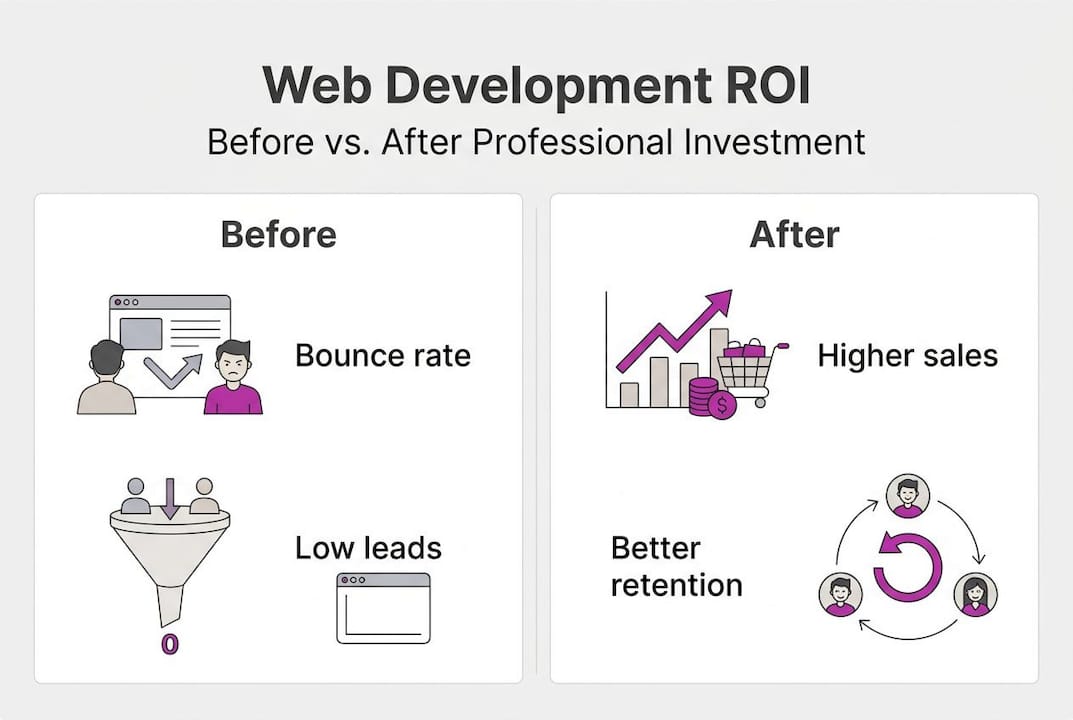
These are not outliers. Professional web development consistently delivers higher ROI for small businesses through improved user experience, faster load times, and cleaner site architecture that search engines reward.
Beyond the numbers, there is a trust dimension. Visitors make a judgement about your business within seconds of landing on your site. A slow, cluttered, or visually dated site signals unreliability before you have said a word. A well-built site signals competence, and competence converts. Learning how to turn website traffic into leads is far easier when the foundation is solid.
- Faster load times reduce abandonment and improve search ranking
- Clear navigation keeps visitors moving towards conversion
- Mobile-optimised layouts capture the majority of web traffic
- Structured data and clean code improve organic visibility
- Integrated client portal benefits add retention value beyond the first visit
Stat to note: Businesses with optimised websites report up to 50% higher revenue growth compared to those running outdated or template-based builds.
Pro Tip: Set up Google Analytics and Search Console before any development work begins. Capturing baseline data means you can measure the exact uplift your investment delivers, and use those numbers to justify future spend. Explore business growth tools that make tracking straightforward from day one.
Agile vs. traditional development: which is right for your business?
How you build your site matters as much as what you build. Two dominant approaches exist: agile (iterative) and waterfall (sequential). Understanding the difference helps you choose the right path for your budget, timeline, and business goals.
Agile development works in short cycles called sprints, typically one to two weeks long. You launch a minimum viable product (MVP) quickly, gather real user feedback, and improve continuously. Agile delivers MVPs in three to six months with 40% faster development cycles than traditional methods. It suits businesses whose requirements are likely to evolve, or who want to test ideas before committing fully.
Waterfall development maps out the entire project before a single line of code is written. Scope, budget, and timeline are fixed upfront. It works well for regulated industries, projects with very clear deliverables, or businesses that need a predictable cost structure.
| Feature | Agile | Waterfall |
|---|---|---|
| Timeline | Flexible, iterative | Fixed, sequential |
| Flexibility | High | Low |
| Risk | Lower (early feedback) | Higher (late discovery) |
| Cost | Variable | Predictable |
| Best for | Startups, evolving products | Fixed-scope, regulated projects |
For startups in particular, prioritise MVP-focused agile with modern tech stacks like Next.js for rapid launch and scaling. Getting something live quickly, learning from real users, and iterating is almost always more valuable than spending six months perfecting something in isolation.
How to choose the right approach for your business:
- Define your scope. If requirements are clear and unlikely to change, waterfall is safer. If you are still learning what your customers need, agile wins.
- Assess your timeline. Need something live in weeks? Agile and WordPress for rapid launches can get you there.
- Consider your budget flexibility. Fixed budgets suit waterfall; variable budgets with room for iteration suit agile.
- Think about your growth stage. Early-stage startups benefit from agile. Established businesses commissioning custom SaaS projects often use hybrid models.
- Factor in your team. Agile requires regular input from your side. If you cannot commit time to feedback cycles, a waterfall approach may be more practical.
DIY vs. professional web development: cost, scalability and risk
The appeal of DIY website builders is obvious. Low upfront cost, no developer required, and you can be live within a day. But the true cost of a DIY site is rarely what it appears at first glance.

Platforms like Wix or Squarespace charge monthly fees that accumulate over time. More significantly, they impose hard ceilings on what your site can do. When your business grows and you need custom integrations, advanced e-commerce logic, or a membership area, you hit a wall. Migrating away from a DIY platform at that point is expensive and disruptive.
Professional development provides scalability, security, and superior user experience, yielding better long-term ROI despite a higher initial investment. The key word is long-term.
Common risks of DIY web development:
- Security vulnerabilities: DIY platforms are frequent targets for automated attacks, and updates are not always applied promptly
- Poor performance: Template-heavy sites often load slowly, hurting both user experience and search ranking
- Limited SEO control: Many builders restrict access to technical SEO settings that matter for organic growth
- Scalability ceiling: Adding complex features often requires a full rebuild rather than an extension
- Hidden time cost: Managing a DIY site yourself pulls focus away from running your business
“The businesses that outgrow their DIY sites fastest are usually the ones that invested in growth early. The rebuild cost later is almost always higher than doing it properly the first time.”
Viewing your professional web services spend as a capital investment rather than an expense reframes the decision entirely. A site that converts 2% of visitors instead of 1% doubles your leads from the same traffic. That return compounds every month.
Pro Tip: When comparing DIY versus professional costs, calculate the value of your own time. If you spend ten hours a month managing a DIY site, and your time is worth £50 per hour, that is £500 a month in hidden cost before you factor in lost growth.
How modern web development ensures robust, reliable websites
A site that goes down at peak traffic, breaks on certain mobile devices, or throws errors on unusual inputs does real damage to your brand. Reliability is not glamorous, but it is foundational.
Modern development practice addresses this through several disciplines. Edge case testing, boundary value analysis, and CI/CD pipelines ensure that websites hold up under real-world conditions, not just ideal ones. An edge case is any scenario outside normal usage: a user entering an unusually long name, a payment failing mid-process, or a page loading on a very old browser. Catching these before launch prevents failures that erode trust.
Test-driven development (TDD) means writing tests before writing code. It sounds counterintuitive, but it forces clarity about what the code needs to do and catches regressions early. Combined with continuous integration, where code changes are automatically tested before deployment, the result is a site that stays stable as it evolves.
Stat to note: Automated testing and CI/CD pipelines prevent up to 50% of production issues that would otherwise reach live users.
Best practices for a reliable, high-performing website:
- Automated test suites covering critical user journeys
- Performance monitoring with alerts for downtime or slowdowns
- Regular WordPress optimisation audits to catch bloat before it becomes a problem
- Staged deployment environments so changes are tested before going live
- Documented rollback procedures for when things do go wrong
The businesses that invest in reliable website development from the start spend far less time firefighting later. Reviewing developer portfolios gives you a clear sense of whether a developer applies these standards in practice.
The real secret: invest for growth, not just aesthetics
Here is something worth saying plainly: most businesses that underinvest in web development do so because they think of it as a design problem. They want something that looks professional. That is a reasonable goal, but it is the wrong frame entirely.
The businesses that scale are the ones that treat their website as a growth engine. They ask different questions. Not “does it look good?” but “does it convert?” Not “is it finished?” but “what does the data say we should improve next?” Turning traffic into leads is a function of strategy, not aesthetics.
After working across dozens of projects, the pattern is consistent. A business that launches a well-structured, fast, conversion-focused site and revisits it quarterly based on analytics will outperform a business that spends twice as much on a beautiful site and then leaves it untouched for three years. The one-off purchase mindset is the single biggest drag on web ROI. Reframe the investment, and everything else follows.
Ready to grow? Here’s how to invest smartly in your next website
If the data in this article has shifted how you think about web investment, the next step is straightforward. Whether you need a fixed-price site to get online quickly or a bespoke build designed around your growth goals, the right starting point is a conversation.
Explore our web development services to see clearly priced packages built for small businesses and startups. For something more tailored, custom website builds are scoped around your specific requirements. You can also review the Conversion Media case study to see how a strategic build translates into measurable business results. Book a free consultation and bring your goals. We will handle the rest.
Frequently asked questions
How does professional web development improve conversion rates?
Professional web development optimises layout, speed, and user flow so visitors find what they need quickly. Conversion rates rise 75% on average after a strategic professional rebuild compared to a template-based starting point.
Is agile or waterfall better for startups?
Agile is usually the stronger choice for startups because it allows rapid iteration based on real user feedback. Agile delivers MVPs in three to six months with 40% faster cycles, making it ideal when speed and flexibility matter most.
What are the main risks of DIY web development?
DIY builds carry hidden costs in time, security, and scalability that often exceed the savings. Professional development yields better ROI over the long term because it avoids the expensive rebuilds that DIY limitations eventually force.
How do testing and automation boost website reliability?
Automated testing catches errors before they reach live users, and CI/CD pipelines ensure every update is validated before deployment. TDD and CI/CD prevent up to 50% of production issues that would otherwise disrupt real visitors.
Recommended
- Why a great developer portfolio brings clients to your door | Rich Harrington
- How WordPress empowers startups to launch and scale | Rich Harrington
- Our Client Portal | Rich Harrington - What You Get When You Work With Us
- Web Design Swindon | Rich Harrington - Custom Website Development
- Why invest in website development for SMBs in Dubai 2026
- Why rapid website deployment matters for enterprise agility - 40Q