Discover what web developers really do beyond building sites, how to choose the right one, and why their technical decisions directly drive business growth.
The real role of a web developer in business growth

TL;DR:
- Most small businesses mistake web development as a one-time build, overlooking ongoing maintenance and optimization.
- Choosing a full-stack developer aligns best with small business needs due to their comprehensive skills.
- Technical decisions by developers in speed and security directly impact business growth and revenue.
Most small business owners think hiring a web developer means getting a website built and that is the end of it. That assumption is costing businesses real money. Web developers create, maintain, and optimise websites and web applications, covering everything from the visual interface to the servers and databases running underneath. The role does not stop at launch. It expands into ongoing performance tuning, security management, and adapting your site as your business evolves. This guide breaks down what web developers actually do, how to choose the right one, and why their technical decisions have a direct impact on your revenue and growth.
Table of Contents
- What does a web developer really do?
- Choosing the right web developer: key roles and collaboration models
- Why performance and security are critical to growth
- The rise of AI and new skills for web developers
- What most guides miss about hiring web developers for growth
- Enhance your business with trusted web development partners
- Frequently asked questions
Key Takeaways
| Point | Details |
|---|---|
| Full-stack advantage | Hiring a full-stack web developer gives small businesses agility and end-to-end expertise for evolving needs. |
| Performance drives results | Even minor improvements in website speed or security can significantly boost conversions and reduce costly risks. |
| AI transforms productivity | AI tools are elevating senior developer output, but require careful management to benefit your business. |
| Long-term partnerships | Ongoing collaboration with developers who understand business goals is more effective than one-off transactions. |
What does a web developer really do?
The simplest way to think about it: a web developer builds the thing your customers interact with and keeps it working reliably. But that description barely scratches the surface.
At the front end, a developer shapes everything a visitor sees and touches. That means the layout, the colours, the buttons, the forms, and how smoothly the page responds on a mobile device. They use HTML to structure content, CSS to style it, and JavaScript to make it interactive. A poorly built front end loses customers before they even read your offer.
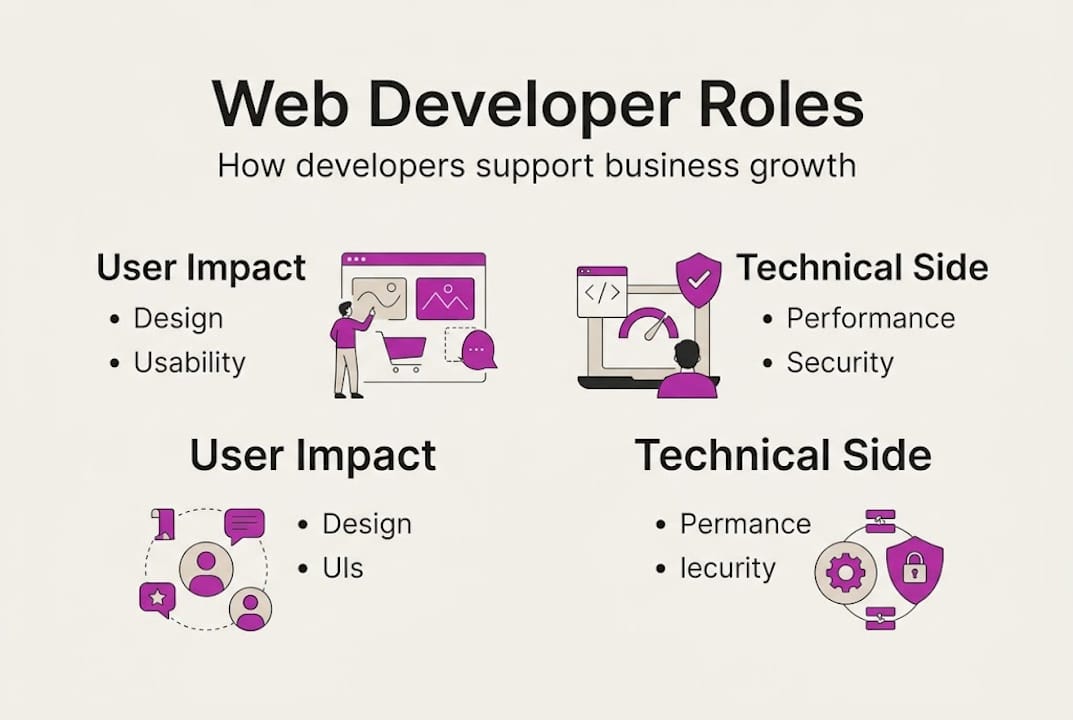
At the back end, the work is invisible but critical. This is the server logic, the database queries, the authentication systems, and the business rules that make your site actually function. When a customer places an order, books an appointment, or submits an enquiry, the back end handles it. If that layer is fragile or poorly designed, your business operations suffer.
As one industry overview puts it:
“Web developers create, maintain, and optimize websites and web applications, handling front-end (UI/UX with HTML/CSS/JS), back-end (servers/databases), and full-stack roles.”
Full-stack developers cover both layers. For small businesses and startups, this is often the most practical option because one person can make coherent decisions across the entire system without handoff delays or communication gaps between separate specialists.
Beyond the initial build, a developer’s ongoing responsibilities include:
- Performance optimisation: compressing assets, reducing load times, and improving Core Web Vitals scores
- Security patching: keeping software dependencies updated and closing vulnerabilities before they are exploited
- Feature development: adding new functionality as your business grows or pivots
- Monitoring and upkeep: catching errors before your customers do
Understanding the broader web design landscape helps frame these responsibilities in context. For newer businesses, platforms like WordPress for startups offer a practical starting point that a skilled developer can build on and extend significantly.
Choosing the right web developer: key roles and collaboration models
Not all web developers are the same, and choosing the wrong type for your stage of business can slow you down considerably.
Here is a quick comparison of the three main developer types:
| Developer type | Strengths | Best suited for |
|---|---|---|
| Front-end | Visual design, UX, speed | Branding-focused projects |
| Back-end | Logic, databases, APIs | Complex data or integrations |
| Full-stack | End-to-end ownership | Startups, SMEs, agile teams |
For most small businesses and startups, a full-stack developer offers the best value. You get someone who understands the whole picture and can make decisions that serve both the user experience and the underlying system without needing to coordinate between multiple specialists.
When it comes to collaboration models, you have three main routes:
- Freelance developer: flexible, cost-effective, ideal for project-based or ongoing retainer work
- Agency: broader team capacity, but often slower, more expensive, and less personal
- In-house developer: full availability, but a significant salary commitment for early-stage businesses
For methodology, the choice between agile and waterfall matters more than most business owners realise. Agile works in short iterative sprints, which suits startups where requirements shift frequently. Waterfall is sequential and works well for fixed-scope projects with clearly defined outcomes from the start. Hybrid approaches are increasingly common in web development, blending structure with adaptability.
Pro Tip: When evaluating any developer or agency, ask how they handle changing requirements mid-project. Rigid processes are a warning sign for growing businesses that need room to adapt.
Exploring the available web development services and understanding the future of full-stack development can help you ask better questions before committing to a partner.
Why performance and security are critical to growth
This is where the technical decisions your developer makes translate directly into pounds and pence for your business.

Speed is not just a nice-to-have. A 0.1 second speed improvement can boost conversion rates by 1 to 3 percent. For a site generating modest revenue, that is a meaningful gain from a single technical improvement. Multiply that across several optimisations and the impact compounds quickly.
Security is even more stark. The average cost of a data breach for small businesses sits at $4.88 million, a figure that includes regulatory fines, customer compensation, reputational damage, and recovery costs. Most small businesses cannot absorb that kind of hit.
Here is a summary of key performance and security metrics worth tracking:
| Metric | Target | Business impact |
|---|---|---|
| Page load time | Under 2 seconds | Reduces bounce rate |
| Core Web Vitals score | Pass all three | Improves Google ranking |
| SSL certificate | Always active | Builds customer trust |
| Dependency updates | Monthly minimum | Closes security gaps |
The tools that make a real difference include:
- Content Delivery Networks (CDNs): distribute your site’s assets globally so pages load faster regardless of where your visitor is located
- Web Workers: run scripts in the background without blocking the main browser thread, keeping your interface responsive
- Security headers: HTTP-level instructions that prevent common attacks like cross-site scripting and clickjacking
Improving WordPress performance is one of the most impactful areas for businesses already on that platform. Getting the technical foundations right also has a direct effect on website traffic and conversions, making it one of the highest-return investments a developer can deliver.
The rise of AI and new skills for web developers
Artificial intelligence is reshaping how developers work, and it has practical implications for what you should expect when hiring in 2026.
AI coding tools can handle a significant portion of routine development work. Studies suggest these tools speed up routine tasks covering 20 to 40 percent of standard coding work. That sounds like a straightforward win, but the reality is more nuanced. The same research found that experienced developers working in complex codebases were actually 19 percent slower when using AI tools, because the suggestions introduced noise rather than clarity.
The takeaway for business owners: AI amplifies senior developers and can slow down junior ones. A developer with deep experience knows when to trust an AI suggestion and when to discard it. A less experienced developer may accept poor output without recognising the problem.
On the salary side, AI skills now command a 12 to 21 percent premium over standard developer rates, reflecting genuine market demand for people who can use these tools effectively.
What this means practically when you are hiring or briefing a developer:
- Ask how they use AI tools in their workflow and what guardrails they apply
- Look for evidence they review AI-generated code rather than shipping it unchecked
- Prioritise developers who can articulate the limits of AI assistance, not just its benefits
- Check whether they stay current with AI for web development trends and tooling
Pro Tip: A developer who dismisses AI entirely is behind the curve. One who relies on it uncritically is a liability. The right answer sits between those two positions.
Understanding the difference between AI-powered IDEs and traditional tooling gives you useful context for those conversations.
What most guides miss about hiring web developers for growth
Most articles about hiring web developers focus almost entirely on technical skills. Can they code in React? Do they know PHP? Have they used AWS? Those questions matter, but they are not the whole picture.
After more than 22 years of building for the web and working directly with businesses at every stage, the pattern is consistent. The projects that go wrong rarely fail because of technical incompetence. They fail because the developer did not understand the business goal, or because communication broke down, or because the engagement was too rigid to adapt when circumstances changed.
A developer who asks sharp questions about your customers, your revenue model, and your growth plans before writing a single line of code is worth far more than one who jumps straight into building. That curiosity signals business awareness, and business awareness produces better technical decisions.
The hidden cost of poor communication compounds over time. Misaligned expectations lead to rework, delays, and frustration on both sides. A lasting partnership, where a developer understands your business deeply and grows with it, consistently delivers better returns than a series of disconnected project engagements.
For businesses exploring platforms like WordPress startup solutions, finding a developer who can advise strategically, not just technically, is the real differentiator.
Enhance your business with trusted web development partners
If this guide has clarified what good web development actually looks like, the next step is finding a developer who delivers it consistently.
Rich Harrington brings over 22 years of full-stack experience to businesses and startups that need reliable, high-quality development without the overhead of a large agency. From bespoke web development and performance optimisation to custom website development built around your specific goals, the focus is always on outcomes that matter to your business. Whether you are starting from scratch or improving what you already have, schedule a consultation to discuss what the right approach looks like for you.
Frequently asked questions
How do web developers help small businesses grow?
Web developers drive growth by optimising site speed, strengthening security, and building functionality that improves the user experience. A 0.1 second improvement in load time alone can lift conversion rates by 1 to 3 percent.
What is the difference between front-end, back-end, and full-stack developers?
Front-end developers focus on design and user interface, back-end developers handle server and database logic, and full-stack developers manage both sides of the system end to end.
Should startups use agile or waterfall methods for web projects?
Agile suits startups that need to adapt quickly, using short iterative sprints to respond to changing requirements. Waterfall works better for fixed-scope projects where the full specification is clear from the outset.
How is AI changing the role of web developers?
AI tools accelerate routine coding tasks and boost productivity for experienced developers, but AI coding tools can actually slow down less experienced developers working in complex codebases, making seniority and judgement more important than ever.
Recommended
- Services | Rich Harrington - Full-Stack Developer
- Why a great developer portfolio brings clients to your door | Rich Harrington
- How WordPress empowers startups to launch and scale | Rich Harrington
- Custom SaaS Development | Rich Harrington - Full-Stack Developer
- How web design drives SEO success for UK businesses