
Discover why SMBs and agencies hire contract developers, when it makes business sense, and how to avoid the common pitfalls that cost time and budget.
Why hire a contract developer? Business benefits & advice

TL;DR:
- Contract developers are increasingly important for SMBs seeking rapid, specialist project support.
- They excel in defined, short-term tasks but are less suitable for continuous product development.
- Human-centric roles like QA and architecture remain resilient despite AI automation advances.
Small businesses and digital agencies have long assumed that contract developers are a luxury reserved for enterprise budgets. That assumption is increasingly hard to defend. SMB demand for project management roles surged by 102% in a single month, signalling a sharp shift in how smaller organisations are approaching specialist hiring. The days of treating contract development as a stopgap measure are over. This article cuts through the confusion, defines exactly what contract developers do, explains when hiring one makes clear business sense, and helps you avoid the common traps that turn a good idea into a costly mistake.
Table of Contents
- Understanding the role of a contract developer
- Top reasons to hire a contract developer for your project
- When not to hire a contract developer: key considerations
- Navigating automation and AI: contract roles that stand the test of time
- Our experience: what truly makes a contract developer worth hiring
- Take the next step: expert contract development for your business
- Frequently asked questions
Key Takeaways
| Point | Details |
|---|---|
| Project-fit advantage | Contract developers provide rapid expertise for defined business needs and deliverables. |
| Demand shaped by AI | Roles combining technical and human oversight are more resilient as automation grows. |
| Hybrid hiring works | Consider blending contract and permanent hires for both agility and continuity. |
| Define outcomes clearly | Clear project scopes and outcome alignment help contract developers deliver lasting value. |
Understanding the role of a contract developer
A contract developer is a technical professional engaged for a specific period, project, or deliverable rather than as a permanent member of staff. The arrangement is typically governed by a statement of work or a fixed-term agreement, which sets out scope, timelines, rate, and deliverables from the outset. That clarity is one of the main advantages over the ambiguity that often surrounds permanent hires.
It is worth separating three commonly confused categories: freelance developers, contract developers, and permanent employees. Freelancers tend to work across multiple clients simultaneously, often on smaller, self-contained tasks. Contract developers are usually engaged through a structured agreement, frequently via an agency, and are expected to integrate more deeply with your team and processes. Permanent employees carry full employment rights, benefits, and long-term expectations on both sides.
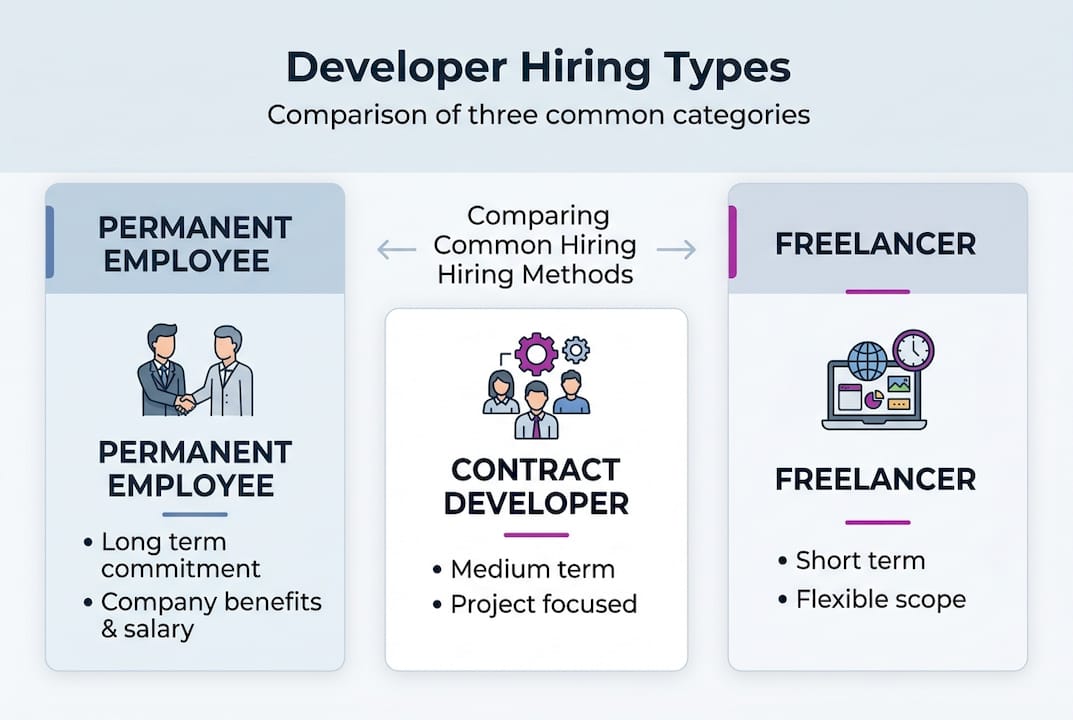
For agencies and SMBs, the contract model sits neatly in the middle. You get someone who shows up, understands your project context, and works as part of your team, without the overhead and commitment of a permanent hire. Contract staffing solutions have matured considerably, making it straightforward to source vetted developers across a wide range of specialisms.
Common contract developer arrangements include:
- Fixed-term contracts: A defined start and end date, often tied to a project milestone or product launch
- Project-based engagements: Scoped to a specific deliverable such as an API integration, e-commerce build, or platform migration
- Remote or onsite: Depending on team preference and the nature of the work
- Part-time or full-time hours: Flexible to match genuine workload rather than assumed headcount
The table below illustrates how the three models compare across key factors:
| Factor | Contract developer | Freelancer | Permanent employee |
|---|---|---|---|
| Commitment level | Medium term | Short term | Long term |
| Team integration | High | Low to medium | Full |
| Cost flexibility | High | High | Low |
| Institutional knowledge | Builds over time | Minimal | Deep |
| Specialist access | High | Variable | Depends on hire |
Project-fit is the most reliable rationale for contract hiring: defined deliverables, fast ramp-up, and flexible burst capacity make it the most practical option for project-driven businesses. A strong developer portfolio also gives you a reliable signal of capability before you commit.
Top reasons to hire a contract developer for your project
Speed is usually the first motivation. When a project lands with a tight deadline, the internal hiring process simply cannot keep pace. A contract developer can be onboarded and contributing within days rather than months. That speed advantage compounds quickly when your project has commercial deadlines attached.

Specialist access is the second major driver. You may need someone who knows a particular framework, platform, or integration inside out, but only for six weeks. Hiring permanently for that level of specialism is difficult to justify. Contract hiring lets you bring in exactly the right skill set without long-term commitment.
SMB project management demand rose 102%, while translation and localisation grew 29% and QA rose 9%, showing that businesses are actively expanding their use of specialist contract roles across functions.
Scalability is the third reason, and it is often underestimated. Product launches, seasonal peaks, and sudden client wins all create bursts of demand that a fixed internal team cannot absorb without strain. Contract developers give you the capacity to meet that demand without inflating your permanent headcount.
Pro Tip: Before you post a contract role, write down the three most important business outcomes you need from this hire. If you cannot articulate those clearly, you are not ready to brief a developer, contract or otherwise.
Consider the comparison below when weighing options for your next technical project:
| Scenario | Best fit |
|---|---|
| Short, well-scoped web build | Contract developer |
| Ongoing platform evolution | Permanent hire |
| Specialist API or integration work | Contract developer |
| Long-term product roadmap | Permanent or hybrid |
| Burst capacity during a launch | Contract developer |
Key business motivations at a glance:
- Faster time to delivery on project-based work
- Access to niche skills without permanent salary commitment
- Scalable support during peaks without long-term risk
- Cost control: pay for what you actually need
- Reduced recruitment risk on uncertain or evolving briefs
For a clearer picture of when to hire contract developers and what to expect from the engagement, it helps to review service options alongside your project brief. Specialist web developer staffing agencies can also help you match skill level to project complexity.
When not to hire a contract developer: key considerations
Contract hiring is not a universal solution. There are situations where it introduces more risk than it removes, and recognising them early saves time and money.
The clearest case against contract hiring is ongoing product development. If your codebase is evolving continuously, if features are being added every sprint, and if the system requires someone with deep context about past decisions, a contract developer will struggle to operate at full effectiveness. They will spend significant time learning what a permanent hire already knows.
Permanent hires deliver long-term integration and institutional knowledge that is especially valuable for continuous roadmap or product work, where decisions build on each other over time.
Here are the scenarios where contract hiring is likely the wrong choice:
- Continuous product development: Where context accumulates and decisions compound over months or years
- Undefined or shifting scope: If you cannot brief a developer clearly, you cannot manage a contract fairly
- High onboarding overhead: Complex legacy systems where knowledge transfer takes longer than the contract itself
- Core team dependency: Where the contractor would become a single point of failure
- Culture-critical roles: Where team cohesion, values alignment, and internal relationships matter as much as output
“A contract developer works best when the boundaries are clear. Bring one in to solve a defined problem, not to carry an undefined one.”
Hybrid models are worth considering for businesses that fall somewhere in the middle. A permanent developer handles the core product and institutional knowledge, while contract developers handle specialist sprints, additional capacity, or specific technical challenges. This approach gives you flexibility without sacrificing continuity.
Pro Tip: If you are unsure whether your project needs a contract or permanent hire, technical consulting can help you map the scope before you commit to a hiring model. Getting that decision right early avoids costly pivots later.
For longer engagements requiring full employment protections, permanent software engineers through specialist recruiters may be the more appropriate route.
Navigating automation and AI: contract roles that stand the test of time
AI has changed the developer hiring landscape, but not in the way most headlines suggest. The tools available in 2026 can generate boilerplate code, assist with documentation, and speed up repetitive implementation tasks. That does create pressure on certain types of contract work.
Freelancers in AI-exposed roles saw roughly a 2% drop in contracts and a 5% decrease in earnings following the rollout of generative AI tools. That is a real but modest shift, and it is concentrated in commodity coding tasks rather than higher-level development work.
The human-centric roles are actually growing. QA, project management, architecture review, and stakeholder collaboration all require judgement, context, and communication that AI tools do not yet replicate reliably. The future of full-stack development increasingly points toward developers who can work alongside AI tools rather than compete with them.
Contract roles with strong resilience to automation:
- Quality assurance and testing: Human judgement catches what automated tests miss, especially in edge cases and user experience
- Technical architecture decisions: Contextual reasoning about trade-offs, constraints, and long-term implications
- Stakeholder communication: Translating business requirements into technical briefs and back again
- Security and hardening: Systems thinking with real-world threat modelling that requires human oversight
- Integration and API work: Connecting disparate systems where requirements are complex and context matters
The table below summarises automation exposure by contract role type:
| Contract role | Automation risk | Demand trend |
|---|---|---|
| Boilerplate code generation | High | Falling |
| QA and testing | Low | Rising (+9%) |
| Project management | Low | Rising (+102%) |
| API integration | Medium | Stable |
| Architecture and consulting | Very low | Rising |
Pro Tip: When writing a contract brief in 2026, specify that the developer will be responsible for oversight, architectural decision-making, and human review of AI-assisted output. That framing attracts senior talent and sets realistic expectations about the role. Security hardening and oversight is one area where this approach is particularly relevant.
Our experience: what truly makes a contract developer worth hiring
Most articles on contract hiring focus on rate cards, platforms, and job descriptions. What they miss is the factor that actually determines whether the engagement succeeds: process alignment.
The best contract developers we have worked with were not necessarily the most technically impressive on paper. They were the ones who asked the right questions before writing a single line of code, who flagged scope ambiguity early, and who communicated blockers clearly rather than working around them in silence. Technical skill is a baseline. Communication and process fit are what separate a good engagement from a frustrating one.
The biggest trap businesses fall into is assuming a contract developer is plug-and-play. They are not. Even a senior developer needs onboarding, context, and access to the right people. Skipping that investment costs you the first two weeks of productivity.
Context-specific hiring consistently outperforms generic skill matching. A developer who has built in your sector, or with your technology stack, will contribute meaningfully from day one rather than spending the first fortnight learning the landscape. Our client portal is built around exactly this principle: giving contract developers the context they need, fast, so that delivery starts immediately.
Match your contract hire to a business outcome, not just a job description, and the results follow.
Take the next step: expert contract development for your business
If this article has helped clarify when and how to bring in contract development support, the logical next step is finding someone who delivers on what it describes.
Rich Harrington is a Senior Full Stack Developer with over 22 years of experience, available for contract and project-based work across web development, API integrations, WordPress builds, and technical consulting. The contract development services on offer are scoped for SMBs and agencies who need reliable, senior-level delivery without the overhead of a permanent hire. Whether you need a custom web solution or expert technical input on an existing project, the starting point is a conversation. Book a consultation and get clarity on scope, timeline, and fit before you commit.
Frequently asked questions
When should I hire a contract developer instead of a full-time employee?
Choose a contract developer for project-based work, fast starts, or when you need specialist expertise for a defined period. Project-fit and burst capacity make contract developers the practical choice for specific, well-scoped deliverables.
Are contract developers at risk from AI automation?
Some routine contract tasks are being automated, but human-centric roles are growing in demand. AI-exposed roles saw reduced contracts of roughly 2%, while QA and project management demand grew by 9% to 102% respectively.
How can I ensure a contract developer contributes effectively?
Provide a clear scope, align on your processes and tools from day one, and integrate the developer with the relevant members of your team early. Skipping onboarding is the single most common reason contract engagements underperform.
What skills should I look for in a contract developer under current trends?
Prioritise quality assurance, project management, architecture, and skills that complement AI output rather than replicate it. Quality assurance and human-centric skills are among the fastest-growing areas of contract demand right now.
Recommended
- Services | Rich Harrington - Full-Stack Developer
- Why a great developer portfolio brings clients to your door | Rich Harrington
- Rich Harrington | Full-Stack Developer & WordPress Expert
- Our Client Portal | Rich Harrington - What You Get When You Work With Us
- 6 proven talent acquisition strategies to attract tech talent