Confused by tech stacks? This plain-English guide helps small business owners understand what a technology stack is, how to choose one, and what it means for cost, speed, and growth.
What is a technology stack? A guide for small businesses

TL;DR:
- Understanding technology stacks helps small businesses make better web development decisions.
- Popular stacks like WordPress, MERN, and Next.js suit different needs and budgets.
- Choosing a simple, well-supported stack ensures better performance, lower costs, and easier scalability.
Most small business owners assume that building a website is primarily about choosing the right colours, fonts, and layout. That belief is understandable, but it leaves out the part that causes the most headaches. Beneath every website or web application sits a collection of technologies that determine how fast it loads, how much it costs to run, whether it can grow with your business, and how easy it is to maintain. Understanding what a technology stack is, and why it matters, puts you in a far stronger position when briefing a developer or evaluating quotes. This article breaks it all down in plain English.
Table of Contents
- Understanding technology stacks: The building blocks explained
- Popular technology stacks for small businesses
- How stack choices affect performance, cost, and scalability
- Choosing your technology stack: Steps and pitfalls
- Stack trends for 2026 and beyond: What’s next?
- Why ‘best’ stack is a myth: The real small business strategy
- Get expert help choosing your technology stack
- Frequently asked questions
Key Takeaways
| Point | Details |
|---|---|
| Tech stack basics | A technology stack is the set of tools, languages, and systems powering your website or app from backend to frontend. |
| Stack choice matters | Your choice affects ongoing costs, performance, talent, and how easily you’ll be able to upgrade later. |
| Keep it simple | Start with the simplest stack that meets your needs—most small businesses don’t need complex custom setups. |
| Think ahead | Pick a stack that scales with your business and avoids lock-in or high long-term maintenance. |
Understanding technology stacks: The building blocks explained
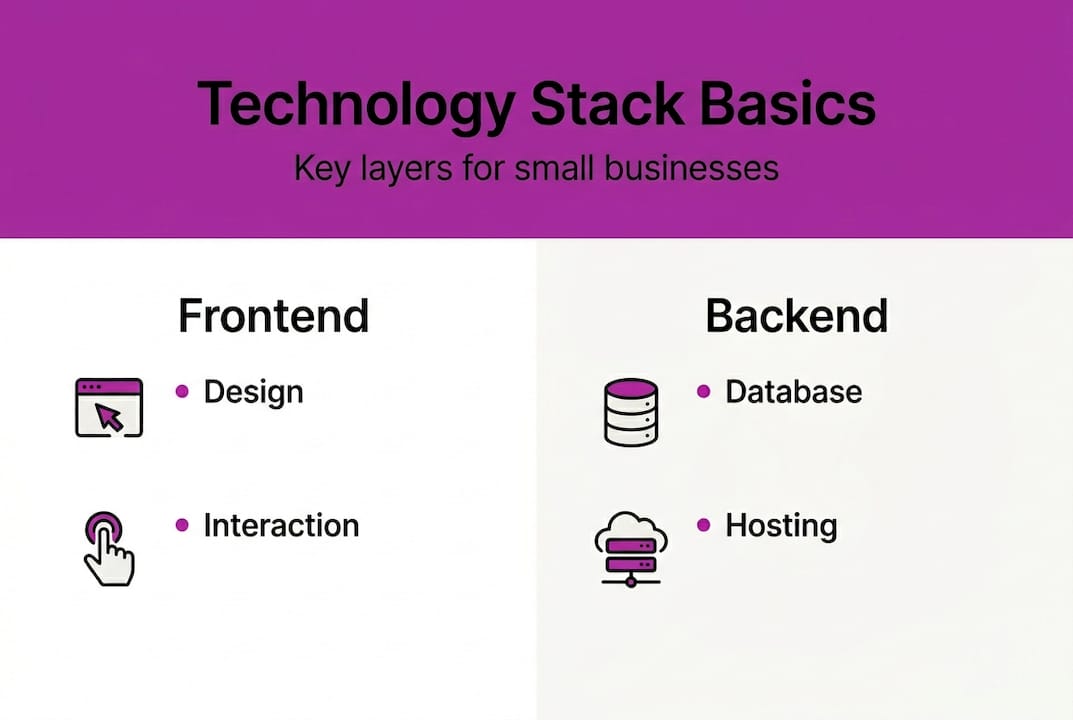
A technology stack is the combination of programming languages, frameworks, libraries, databases, servers, and tools used to build, deploy, and maintain a web application. Think of it less like a single product and more like a set of specialist tradespeople working together. Just as a house needs a foundation, walls, plumbing, and electrics, a website needs distinct layers of technology, each doing a specific job.
The core stack layers are typically broken down as follows:
- Frontend: What users see and interact with. Built using HTML, CSS, and JavaScript, often with frameworks like React, Vue, or Angular.
- Backend: The logic engine behind the scenes. Common choices include Node.js, Python, PHP, and Java.
- Database: Where your data lives. Relational databases like PostgreSQL and MySQL store structured data; NoSQL options like MongoDB handle more flexible formats.
- Infrastructure: The servers and hosting environment. Options range from traditional hosting to cloud platforms like AWS and Vercel.
Here is a quick overview of each layer and the technologies you are likely to encounter:
| Stack layer | What it does | Popular technologies |
|---|---|---|
| Frontend | User interface and experience | React, Vue, Angular, HTML/CSS |
| Backend | Business logic and APIs | Node.js, PHP, Python, Java |
| Database | Data storage and retrieval | PostgreSQL, MySQL, MongoDB |
| Infrastructure | Hosting and deployment | AWS, Vercel, Netlify, cPanel |
The stack you choose shapes every technical decision that follows, from how quickly pages load to how much a developer will charge to maintain the site.
For small businesses exploring website development basics, understanding these layers helps you ask better questions and avoid being locked into a solution that does not fit your actual needs. Stack choices made at the start of a project have a direct impact on long-term cost, the ease of adding new features, and whether future developers can pick up the work without starting from scratch.
Popular technology stacks for small businesses
With the foundational pieces of technology stacks clear, let’s see which options make sense for different business scenarios.
Not every business needs the same solution. A local trades company launching a five-page brochure site has very different requirements from a startup building a customer portal. The right stack for small businesses is typically the simplest one that meets your current needs without over-engineering for problems you do not yet have.

Here is a comparison of the most common stacks used for small business projects:
| Stack | Best for | Cost level | Maintenance ease |
|---|---|---|---|
| WordPress / LAMP | Brochure sites, blogs, small shops | Low | Easy |
| MERN (MongoDB, Express, React, Node) | Custom web apps, dashboards | Medium | Moderate |
| Next.js / Jamstack | Fast content sites, marketing pages | Low to medium | Easy to moderate |
| SvelteKit / Astro | Performance-focused sites, static content | Low | Easy |
WordPress on a LAMP stack (Linux, Apache, MySQL, PHP) remains the most widely used option for small businesses. It is cost-effective, has a massive support community, and requires no custom development to get started. If you are curious how this translates to real growth, WordPress for startups covers the practical advantages in detail.
MERN and Next.js are better suited to businesses that need custom functionality, such as booking systems, client portals, or data-driven features. These stacks offer more flexibility but require more experienced developers and higher ongoing maintenance investment. For businesses considering a software product, SaaS app development explores what that journey looks like.
- WordPress: Ideal for most small business websites with limited budget
- MERN: Good for interactive applications needing real-time data
- Next.js / Jamstack: Strong choice for fast, SEO-friendly marketing sites
- SvelteKit / Astro: Excellent for lightweight, high-performance static sites
Pro Tip: Start with the simplest stack that solves your immediate problem. Upgrading later is always possible. Rebuilding an over-engineered system from scratch is expensive and disruptive.
How stack choices affect performance, cost, and scalability
Understanding which stack to use is only part of the puzzle. How your stack decisions play out in real business terms is where things get genuinely consequential.
Speed matters more than most business owners realise. A slow website costs you visitors, search rankings, and sales. 2026 benchmarks show SvelteKit leading full-stack performance at 1,200 requests per second with a bundle size of just 42KB, compared to Next.js at 120KB. Astro excels for static sites with a 58KB bundle, while Next.js retains a strong ecosystem and hiring pool. These are not abstract numbers. Smaller bundles mean faster page loads, which directly affects your conversion rate.
Cost is shaped by several stack-related factors:
- Hosting costs: Serverless and static deployments on platforms like Vercel or Netlify can dramatically reduce running costs compared to traditional VPS hosting.
- Developer availability: Popular stacks like WordPress and React have larger talent pools, which keeps hiring costs competitive.
- Maintenance burden: Simpler stacks with strong community support require less specialist intervention over time.
- Vendor lock-in: Proprietary platforms can trap you into rising costs with no easy exit. Open-source stacks give you freedom.
Scalability is another consideration worth thinking through before you build. A stack that handles 500 visitors a month may buckle under 50,000. Understanding tech stack trade-offs before committing helps you avoid expensive rewrites later. For a broader view of where the industry is heading, full-stack future trends is worth reading alongside this.
Pro Tip: Choose a stack that supports your business needs for the next two to three years, not just launch day. What you need at month one and month eighteen are often very different things. If your site needs ongoing attention, WordPress maintenance insights outlines what that typically involves.
Choosing your technology stack: Steps and pitfalls
Armed with an understanding of what is out there and what factors to weigh, it is vital to follow a clear, risk-aware selection process.
Here is a practical approach to narrowing down your options:
- Define your core requirements. What does your site or app actually need to do? List the must-have features before looking at any technology.
- Assess your budget and timeline. Some stacks require more upfront development time. Know what you can realistically spend.
- Consider your team or developer. The best stack in the world is useless if your developer does not know it well. Match the stack to the available expertise.
- Evaluate long-term support. Is the framework actively maintained? Does it have a strong community? Abandoned frameworks become liabilities.
- Run a small pilot. Before committing fully, build a prototype or proof of concept to test your assumptions.
JS stacks like MERN enable full-stack JavaScript development but risk complexity and maintenance overhead. More opinionated stacks like Django or Laravel enforce structure, which tends to produce more stable, maintainable codebases over time.
Common mistakes to avoid:
- Choosing a stack because it is trendy rather than because it fits your needs
- Underestimating the ongoing maintenance cost of complex frameworks
- Building in features you do not need yet, adding unnecessary technical debt
- Ignoring the availability of developers who know the stack you have chosen
Static sites favour Astro for zero JavaScript overhead, while real-time applications are better served by Node.js or SvelteKit. Conducting a regular stack audit is a useful habit as your business grows.
Many maintenance headaches come from over-complicated stacks chosen to impress rather than to serve. Simplicity is not a compromise. It is a strategy.
Stack trends for 2026 and beyond: What’s next?
To round out your decision-making, it pays to know what is around the corner in web technology stacks.
The direction of travel is clear. Developers and businesses alike are moving towards lighter, faster, and cheaper-to-run solutions. 2026 benchmarks confirm SvelteKit leading full-stack performance, Astro excelling for static content, and Next.js maintaining its position through ecosystem strength and developer familiarity.
Here is what is likely to matter most between 2026 and 2028:
- Serverless and edge computing: More sites will run on distributed infrastructure, reducing hosting costs and improving global load times.
- Static-first thinking: Generating pages at build time rather than on each request is becoming the default for content-heavy sites.
- Smaller, faster frameworks: The shift away from heavy JavaScript bundles is accelerating. Astro and SvelteKit are leading this change.
- AI-assisted development: Tooling that helps developers write and review code faster is already changing how stacks are built and maintained.
- Talent availability: Stacks with large communities will be easier and cheaper to hire for, which matters as your business scales.
For small businesses, the practical takeaway is straightforward. Do not chase the newest framework. Instead, watch which tools are gaining community momentum and developer adoption. For a deeper look at where the industry is heading, stack evolution insights covers the longer-term picture.
Future-proofing your stack is less about predicting the future and more about avoiding choices that will box you in. Open-source, well-supported, and widely understood technologies give you the most options as your needs evolve.
Why ‘best’ stack is a myth: The real small business strategy
After more than 22 years of building for the web, one pattern stands out clearly. Businesses that spend the most time searching for the perfect stack almost always end up with a worse outcome than those who pick something sensible and get moving.
There is no universally best technology stack. What works brilliantly for a SaaS startup with a full engineering team will be overkill and overpriced for a local service business that needs a clean, fast website and a contact form. Chasing trends is expensive. A framework that is exciting at a tech conference may have a tiny talent pool, poor documentation, and no long-term maintenance guarantee.
Choosing a stack is like choosing tools. The best one is whatever makes your business move faster, not whatever is cool today.
The real strategy is to prioritise maintainability, cost, and community support over feature lists and novelty. A site built on WordPress that your team can update without a developer on call is worth more than a cutting-edge React application that breaks every time a dependency updates. Focus on what serves your business, not what impresses other developers.
Get expert help choosing your technology stack
Making the wrong stack choice at the start of a project is one of the most common and costly mistakes small businesses make. The right decision depends on your specific goals, budget, and growth plans, not on what is trending in developer circles.
Rich Harrington has over 22 years of experience helping businesses choose and build the right technology for their needs, from simple WordPress sites to custom full-stack applications. Whether you need a new site, a technical review of your current setup, or a bespoke application built from the ground up, the full-stack development services on offer cover the full range. If you want a straightforward conversation about what your business actually needs, schedule a stack consultation and get clarity without the jargon.
Frequently asked questions
What is included in a technology stack?
A technology stack includes the frontend and backend frameworks, databases, programming languages, servers, and infrastructure needed to build and run a website or web application.
Which technology stack should a small business use for a basic website?
WordPress on LAMP is typically the most cost-effective and easiest-to-maintain choice for most small business websites, offering a large support community and low running costs.
Does my tech stack choice really impact site speed and costs?
Yes, significantly. 2026 benchmarks show SvelteKit achieving 1,200 requests per second with a 42KB bundle, while Astro excels for static sites, both outperforming heavier alternatives on speed and running costs.
How do I future-proof my business with the right stack?
Choose a stack with strong community support, open-source foundations, and flexibility for scalability, so your technology can adapt as your business requirements change over time.