Discover how developers drive digital transformation for small businesses, solving legacy system issues, skill gaps, and inefficiency with custom solutions.
How developers drive digital transformation for SMEs
TL;DR:
- True digital transformation requires custom solutions aligned with business processes and goals.
- Developers are strategic partners who address legacy systems, automate workflows, and enhance competitiveness.
- Ongoing collaboration, agile methods, and clear briefs ensure successful SME digital transformation efforts.
Most small business owners assume digital transformation means signing up for a new project management tool or switching to cloud storage. That assumption is understandable, but it misses the point almost entirely. Real transformation happens when technology is shaped around your specific processes, your customers, and your goals. That is precisely where a skilled developer becomes essential. Off-the-shelf software can only take you so far. When your operations have unique requirements, a developer is the person who bridges the gap between generic tools and solutions that genuinely work for your business.
Table of Contents
- Understanding digital transformation in small businesses
- The developer’s key skills and methodologies
- Developers as problem solvers: Overcoming SME challenges
- Practical steps: Engaging developers for your transformation
- Why small businesses should see developers as strategic partners
- Start your digital transformation journey with expert developer support
- Frequently asked questions
Key Takeaways
| Point | Details |
|---|---|
| Developers drive real change | Developers bridge skill gaps and modernise legacy systems for tangible business impact. |
| Agile delivers adaptability | Using agile methods enables flexible, iterative improvements for evolving business needs. |
| Collaboration trumps technology alone | Strong teamwork and clear communication are essential for digital tools to succeed. |
| Custom solutions beat off-the-shelf | Tailored development unlocks better operational efficiency and growth for SMEs. |
Understanding digital transformation in small businesses
Digital transformation, in practical terms for a small or medium-sized enterprise (SME), means using technology to fundamentally improve how you operate, serve customers, and compete. It is not a single project. It is an ongoing shift in how your business functions.
SMEs typically pursue transformation for three core reasons:
- Operational efficiency: Automating repetitive tasks, reducing manual errors, and freeing up staff time
- Growth: Reaching new markets, scaling services, or launching digital products
- Competitiveness: Keeping pace with larger competitors who already have mature digital infrastructure
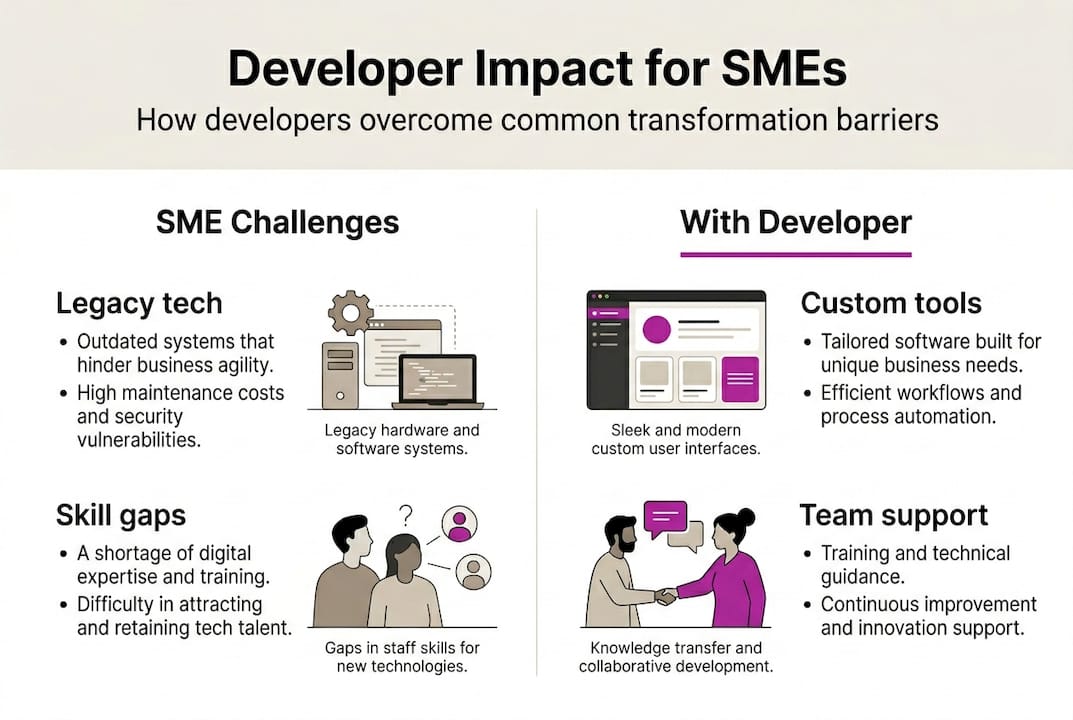
The challenge is that the path from intention to outcome is rarely straightforward. Barriers to digital transformation for SMEs include legacy systems that cannot integrate with modern tools, internal skill gaps where staff lack the knowledge to implement or manage new technology, and cultural resistance to change from teams accustomed to existing workflows.
These are not small hurdles. A legacy system, for example, might be a ten-year-old database that stores all your customer records but cannot connect to any modern CRM platform. Buying a new CRM does not solve the problem. You need someone who can build the bridge between old and new, migrate data safely, and ensure nothing breaks in the process.
This is where developers earn their place. They do not just write code. They analyse your current systems, identify where the friction is, and design solutions that fit your actual situation. Whether that means building a custom integration, replacing a legacy tool with something purpose-built, or providing technical consulting support to map out a realistic roadmap, a developer turns abstract goals into working systems.
For SMEs, this matters enormously. You do not have the budget or the time to get it wrong twice. A developer who understands your business context is not a luxury. They are a practical necessity for transformation that actually sticks.
The developer’s key skills and methodologies
Understanding what a developer brings to a transformation project goes beyond knowing they can write code. The technical skills are broad: front-end and back-end development, API integration (connecting different software systems so they share data), database design, security implementation, and performance optimisation. Each of these plays a role in building systems that are reliable and scalable.
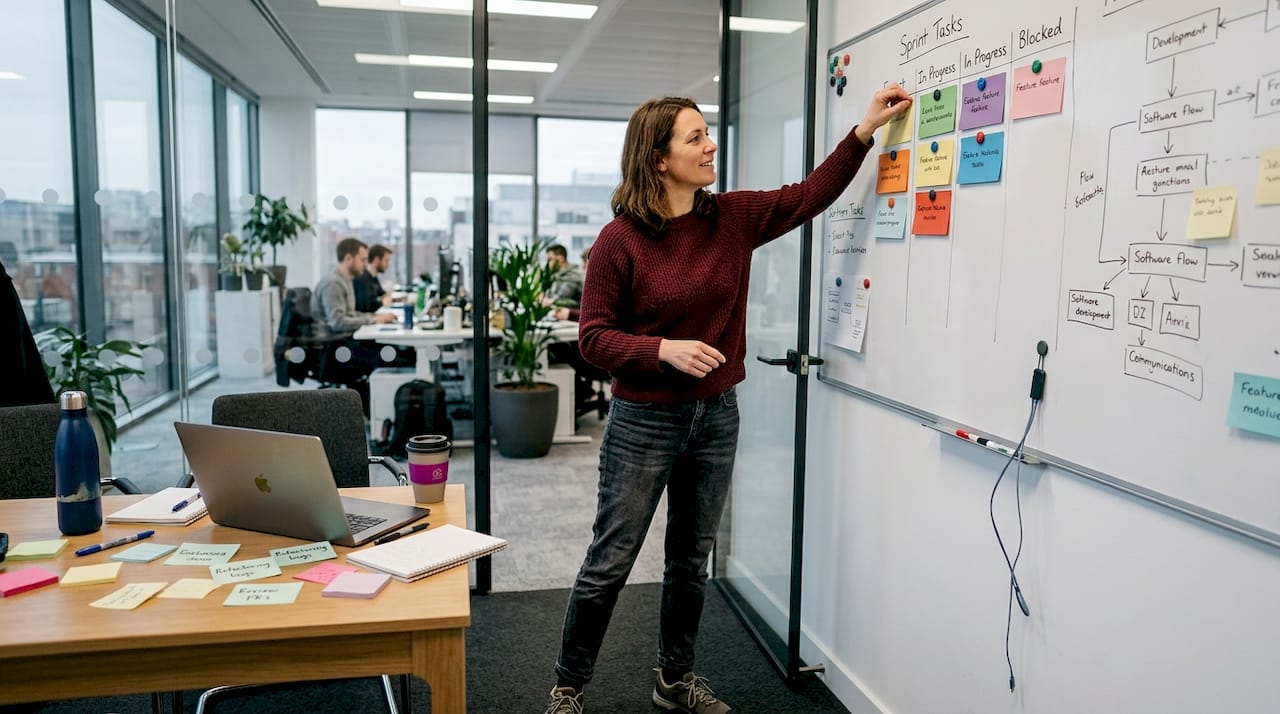
But methodology matters just as much as technical ability. Most experienced developers working on transformation projects use agile approaches. Agile is a way of working that breaks a project into short cycles called sprints, typically one to two weeks long. At the end of each sprint, you review what has been built and adjust the plan based on what you have learned.
The agile development process enables iterative delivery, collaboration, and adaptability, which is exactly what transformation projects need because requirements change as understanding grows. You rarely know everything upfront. Agile accounts for that reality.
Here is a comparison of traditional versus agile approaches in transformation projects:
| Aspect | Traditional approach | Agile approach |
|---|---|---|
| Planning | Fully defined upfront | Evolves through sprints |
| Delivery | One large release | Incremental releases |
| Feedback | At the end | Continuous throughout |
| Risk | High if requirements change | Lower, adjustments built in |
| Business involvement | Minimal after briefing | Active throughout |
Adaptability is also a core developer trait. Business needs shift. A developer who built your initial system should be able to extend it as your requirements evolve, whether that means adding new features, integrating with a third-party platform, or scaling infrastructure to handle more users. This is especially relevant for custom SaaS development, where the product must grow alongside the business.
Pro Tip: When briefing a developer, do not just describe what you want built. Describe the problem you are trying to solve. A good developer will often suggest a better solution than the one you had in mind.
Developers as problem solvers: Overcoming SME challenges
Theory is useful, but what does developer involvement actually look like in practice? Let us walk through the most common SME challenges and how a developer addresses each one.
1. Legacy systems holding back growth Old software often cannot connect to modern tools. A developer can build custom integrations or migrate your data to a new platform without losing historical records. The Fleming and Partners project is a good example of replacing fragmented systems with a cohesive digital solution.
2. Operational inefficiency from manual processes If your team is copying data between spreadsheets or manually sending routine emails, a developer can automate those workflows. This reduces errors and frees staff to focus on higher-value work.
3. Skill gaps within the team Most SME teams are not technical. A developer does not just build the solution. They document it, train the team on how to use it, and design interfaces that are intuitive enough that staff do not need to be developers themselves.
4. Resistance to change New systems fail when people do not trust them. Developers who involve end users during the build process, gathering feedback and adjusting accordingly, produce tools that staff actually want to use. The MaintainHQ development project demonstrates how user-centred development reduces friction at the adoption stage.
Here is a quick comparison of outcomes with and without developer involvement:
| Challenge | Without a developer | With a developer |
|---|---|---|
| Legacy system | Workarounds, data silos | Custom integration or migration |
| Manual processes | Staff time wasted | Automated, consistent workflows |
| Skill gaps | Underused tools | Tailored, documented systems |
| Resistance to change | Low adoption | User-tested, trusted solutions |
The pattern is consistent. SME transformation barriers including legacy systems, skill gaps, and resistance to change are solvable. The solution in each case involves a developer who understands both the technical and human sides of the problem.
Practical steps: Engaging developers for your transformation
Knowing you need a developer and knowing how to work with one effectively are two different things. Here is how to approach the process.
Finding the right developer
Look for someone with a track record in your type of project. A developer portfolio is one of the clearest signals of capability and communication style. Review past projects for complexity, variety, and evidence of problem-solving rather than just visual polish.
Building a clear project brief
Your brief should cover:
- The business problem you are trying to solve
- Current systems in use and any known constraints
- Desired outcomes, not just features
- Timeline expectations and any hard deadlines
- Budget range, even a rough one
Being specific upfront saves significant time and avoids scope creep later.
Ensuring ongoing collaboration
Do not hand over a brief and disappear. The best transformation projects involve regular check-ins, feedback on prototypes, and open dialogue about what is and is not working. Agile collaboration principles place business stakeholders at the centre of the process, not on the outside waiting for a finished product.
Pro Tip: Build in a feedback cycle at the end of every sprint. Even a fifteen-minute review call keeps the project aligned with your actual needs and prevents costly rework.
“The businesses that see the greatest return from digital transformation are those that treat their developer as a thinking partner, not just a pair of hands.”
This is not just good advice. It is the difference between a project that delivers and one that gets shelved after launch.
Why small businesses should see developers as strategic partners
Most businesses still think of developers as people you call when something is broken or when you need a website built. That framing costs you. A developer who understands your business model can actively shape how technology supports your growth, not just maintain what already exists.
The real value of a developer is not in the code they write. It is in the decisions they inform. Which systems should integrate? Where is the automation opportunity? What would a custom tool enable that no off-the-shelf product can? These are strategic questions, and a senior developer has the experience to answer them.
Businesses that involve developers early, before requirements are locked down, consistently get better outcomes. They avoid building the wrong thing. They spot technical constraints before they become expensive problems. Exploring the future of full-stack development makes clear that the developer’s role is expanding, not narrowing. The businesses that recognise this now will be better positioned as technology continues to evolve.
Treat your developer as a strategic partner from day one. The returns are measurably better.
Start your digital transformation journey with expert developer support
If this article has clarified anything, it is that digital transformation is not a software purchase. It is a process, and it needs the right technical partner to deliver real results.
Rich Harrington is a Senior Full Stack Developer with over 22 years of experience helping businesses build technology that fits. From custom SaaS development to full-stack builds and API integrations, the work is always shaped around your specific goals. If you are ready to move beyond generic tools and build something that genuinely works for your business, explore the full range of developer services for SMEs and find out how to get started.
Frequently asked questions
What does a developer do in digital transformation projects for small businesses?
A developer customises and builds technology to replace outdated systems, streamline operations, and help small businesses stay competitive. SME transformation barriers such as legacy systems and skill gaps are directly addressed through custom solutions.
How do agile methodologies help with digital transformation?
Agile allows businesses to introduce new technologies in small steps, adapting quickly to evolving needs while reducing risk. The agile development process builds in regular feedback so the final product reflects real business requirements.
How should I brief a developer for digital transformation?
Outline your business goals, current pain points, and desired outcomes before starting. This gives the developer enough context to design targeted solutions rather than just building to a feature list.
What’s the biggest mistake SMEs make with developers?
Many treat developers as mere technicians rather than strategic partners, which limits the broader business benefits they could otherwise gain from the relationship.
Recommended
- Services | Rich Harrington - Full-Stack Developer
- Custom SaaS Development | Rich Harrington - Full-Stack Developer
- Why a great developer portfolio brings clients to your door | Rich Harrington
- The Future of Full-Stack Development | Rich Harrington
- Digital Transformation for Sales: Driving B2B Growth