Discover which web development roles suit your business stage and goals. A practical guide to front-end, back-end, full-stack, CMS, and e-commerce specialists.
Essential web development roles for small business success

TL;DR:
- Choosing the right web development roles depends on your business stage and specific needs.
- Small businesses often benefit from full-stack developers or a web designer and CMS specialist combo.
- Ongoing support and tailored expertise are crucial for website growth, security, and performance.
Choosing the right web development expertise for your business is one of those decisions that looks straightforward until you are actually in it. The job titles alone, front-end, back-end, full-stack, DevOps, can feel like a foreign language. Get it wrong and you overspend, delay your launch, or end up with a site that cannot grow with you. Get it right and your web presence becomes a genuine business asset. This article walks you through the main web roles, what each actually does, and how to match them to your specific stage and goals so you can make a confident, cost-effective decision.
Table of Contents
- How to map your needs to key web roles
- Breakdown of the main web development roles
- Comparison table: Who does what and when to hire
- Choosing the right role for your business stage
- Our take: Making your investment in web roles count
- Next steps: Simplify your web development journey
- Frequently asked questions
Key Takeaways
| Point | Details |
|---|---|
| Role clarity matters | Knowing which web experts you need prevents wasted budget and speeds up your project. |
| Front-end vs back-end | Front-end handles visuals, back-end powers the logic—modern sites need both. |
| Hybrid skills are rising | Full-stack and multi-skilled developers offer more flexibility for smaller teams. |
| Match roles to growth | Choose and phase in talent based on your business stage, not just your launch goals. |
How to map your needs to key web roles
Before you start comparing developer rates or posting a job brief, you need to be clear about what you actually need. This sounds obvious, but most small business owners skip this step and jump straight to hiring based on a vague requirement like “build me a website.” That leads to either overpaying for skills you do not need or underpaying for a generalist who cannot deliver what you require.
Start by defining your objective:
- New informational site: You need a web designer and possibly a CMS developer.
- Online shop: You need an e-commerce developer, often supported by a back-end developer for payment and inventory logic.
- Custom web application or tool: You need a full-stack developer or a combination of front-end and back-end specialists.
- Ongoing updates and maintenance: You need either a CMS developer or a retained developer relationship.
- Performance, security, or hosting issues: You need a DevOps engineer or a developer with infrastructure experience.
Main types of web development roles include Front-End Developer, Back-End Developer, Full-Stack Developer, Web Designer, E-commerce Developer, CMS Developer, DevOps Engineer, and a range of specialised roles beyond these. Each exists because the discipline is genuinely broad. Assuming one person can handle everything at the same level of quality is one of the most common and costly mistakes small businesses make.
Another frequent pitfall is hiring too narrowly. Bringing in a designer with no development knowledge, then separately hiring a developer with no design sense, often doubles cost and creates friction during handover. If technical consulting help is available early in your project, use it. A short scoping conversation can save weeks of rework.
Pro Tip: Look for hybrid roles where your budget is tight. A full-stack developer who can also produce clean, functional design work can cover two phases of a project without the communication overhead of separate hires. This is particularly effective for early-stage businesses that need speed and simplicity over perfection.
Breakdown of the main web development roles
Understanding what each role actually does day-to-day makes hiring or outsourcing far simpler. Here is what you need to know.
Front-end, back-end, and full-stack are the foundational web development categories, with growing emphasis on specialisms like mobile, e-commerce, and CMS. Let us break each one down:
- Front-end developer: Builds what users see and interact with. Buttons, layouts, navigation, animations. Works primarily with HTML, CSS, and JavaScript.
- Back-end developer: Manages servers, databases, and the logic that powers your site behind the scenes. Think user logins, order processing, and data storage.
- Full-stack developer: Works across both front-end and back-end. As full-stack developer role definitions clarify, this covers everything from interface to infrastructure, making it ideal for smaller projects needing one capable pair of hands.
- Web designer: Focuses on visual identity, user experience, and layout. Not always a developer. Often works in tools like Figma before handing designs to a developer.
- E-commerce developer: Specialises in platforms like Shopify, WooCommerce, or bespoke shop builds. Understands payment gateways, product catalogues, and conversion optimisation.
- CMS developer: Customises content management systems like WordPress, Craft CMS, or Drupal so non-technical teams can manage content independently.
- DevOps engineer: Handles hosting infrastructure, deployment pipelines, automated testing, and uptime monitoring. Critical at scale, less so at launch.
- Cybersecurity specialist: Audits and hardens your site against attacks. Important for e-commerce and any site handling personal data.
For most small businesses, a strong full-stack developer or a web designer working alongside a CMS specialist covers the vast majority of project requirements. You can explore career paths in more depth if you want a broader picture of the industry landscape.
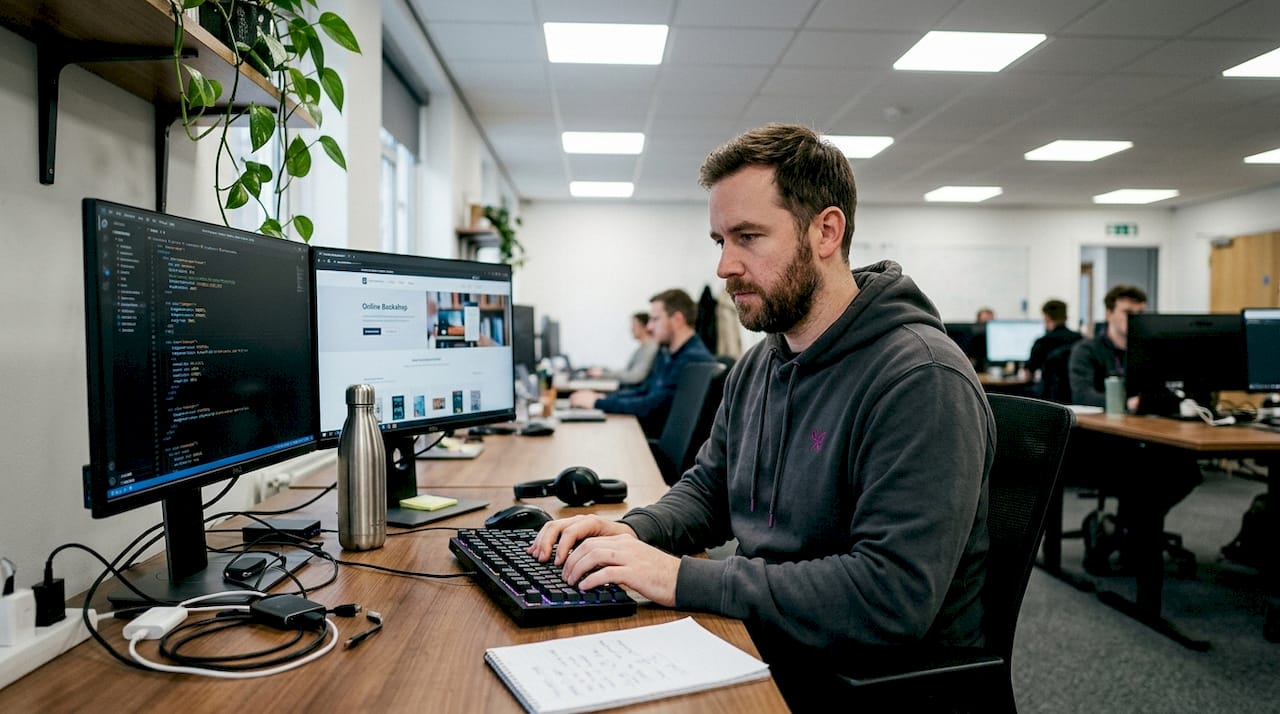
For businesses considering SaaS tools or application-layer products, SaaS development guidance is worth reviewing before you define your technical requirements. And if you are still unclear on how web design roles differ from development roles, it is a distinction worth understanding before you write a brief.
Pro Tip: Bundling the design and build phases with a single developer or team who can do both almost always speeds up launch. Handovers between design and development are where timelines slip most often.
Comparison table: Who does what and when to hire
Here is a side-by-side view of the main roles so you can match them to your situation at a glance. Front-end, back-end, and full-stack developer tasks are distinct but frequently overlap in practice, especially on smaller projects.
| Role | Core responsibilities | Best for |
|---|---|---|
| Front-end developer | UI layout, interactivity, browser compatibility | Sites needing strong visual polish |
| Back-end developer | Databases, APIs, server logic | Complex data-driven applications |
| Full-stack developer | End-to-end build, front and back | Most small to medium business projects |
| Web designer | Visual design, UX, branding | Early-stage brand and layout work |
| E-commerce developer | Shop builds, payments, inventory | Online retail and product businesses |
| CMS developer | Platform customisation, content workflows | Businesses managing their own content |
| DevOps engineer | Hosting, deployment, performance | Growing sites with uptime requirements |
| Cybersecurity specialist | Security audits, hardening, compliance | E-commerce and data-handling businesses |
When to bring each role in:
- Pre-launch: Web designer, full-stack or front-end developer, CMS developer.
- At launch: E-commerce developer if selling online, back-end developer for complex logic.
- Post-launch growth: DevOps engineer for scaling, cybersecurity specialist for risk management.
- Ongoing: CMS developer or retained full-stack developer for updates and new features.
The future of full-stack work points clearly toward developers who can span multiple disciplines, which is worth factoring into any long-term hiring plan.
Choosing the right role for your business stage
Your current business stage should drive your hiring decisions more than any other single factor. Aligning web development expertise with both current and future business requirements is what separates projects that scale from those that need expensive rebuilds eighteen months in.
Here is a simple decision process:
- Define your goal. Is this a launch, a redesign, or a feature addition?
- List your technical requirements. Do you need a database, e-commerce, login system?
- Set a realistic budget and timeline.
- Match those to the role or roles above.
- Decide whether to hire, outsource, or use a retained developer.
| Business stage | Typical role needs | Priority skills |
|---|---|---|
| Start-up (first site) | Full-stack developer or web designer + CMS dev | Speed, simplicity, SEO basics |
| Small online shop | E-commerce developer, back-end support | Payment integration, product management |
| Growing business | Full-stack + DevOps, possible cybersecurity | Scalability, performance, uptime |
| Mature, data-heavy site | Specialist back-end, DevOps, security | Architecture, reliability, compliance |
If you are at the start-up stage, custom website development packages designed for small businesses can get you to market without the overhead of a full agency. As your site grows, DevOps and security options become increasingly relevant. Custom design considerations are also worth reviewing if you are deciding between a template and a bespoke build.
Phasing your hires is a practical way to manage cost. You do not need every role on day one. Start with what gets you live, then layer in specialists as your traffic and complexity grow.
Our take: Making your investment in web roles count
The most persistent myth in web development resourcing is that you need to hire for everything before you launch. In practice, that approach burns budget before you have any evidence of what your users actually need. Businesses that launch lean, gather real data, then invest in specific expertise based on what they learn almost always get better returns.
The other thing worth saying clearly: ongoing support matters as much as the launch itself. Too many businesses treat their website as a one-time project rather than a living part of their operation. Sites that are not maintained degrade in performance, security, and search visibility over time.
Look at a developer’s track record across different project types before committing. A strong developer portfolio tells you far more than a job title or a list of technologies. Real projects, with real outcomes, are the only reliable signal that someone can deliver what you need.
Next steps: Simplify your web development journey
If this article has clarified what you need but you are still unsure how to find the right person or team, that is where tailored guidance makes the difference.
Rich Harrington offers full-stack expertise built over 22 years of real project delivery, covering everything from WordPress builds and e-commerce to API integrations and infrastructure. Whether you need a one-off build or a longer-term development partner, the web development services on offer are structured to fit different business sizes and budgets. Start with a look at the custom website solutions available, or get in touch directly to talk through your project without any commitment. Clear, straightforward advice is always the first step.
Frequently asked questions
Which web development role should I prioritise for a new small business website?
Most small businesses benefit from a full-stack developer or a web designer paired with a CMS specialist for fast, cost-effective results. A full-stack developer handles both front-end and back-end requirements, reducing the number of people you need to coordinate.
What is the main difference between front-end and back-end developers?
Front-end developers work on the visual parts users see, while back-end developers manage databases, servers, and logic behind the scenes. The distinction between these roles is well established, though many projects benefit from someone who can do both.
Do I need a DevOps or cybersecurity specialist for my business website?
For most small businesses, these roles become important only as your traffic and complexity increase, but early advice can prevent costly security gaps. DevOps and cybersecurity roles are specialised and are most often engaged as needs grow rather than from day one.
What is a CMS developer, and do I need one?
A CMS developer customises platforms like WordPress or Shopify, ideal if you want easier self-maintenance or rapid content updates. CMS development is a key role for any business that wants flexible, staff-managed web content without relying on a developer for every change.