
Learn how effective briefing a developer for a SaaS build can streamline your project, reduce costs, and ensure success.
Briefing a developer for a SaaS build: 2026 guide

Briefing a developer for a SaaS build is the process of creating a structured written document that communicates your product vision, user needs, technical requirements, and priorities before a single line of code is written. In the industry, this document is formally called a software development brief or product requirements document (PRD). A well-written brief is the single most important thing you can do before engaging any developer or agency. A clear brief reduces quote variance from a $15,000 to $150,000 range down to three quotes within 20% of each other. That gap is not a pricing problem. It is a communication problem, and the brief is the fix.
What are the essential components of a SaaS development brief?
A SaaS development brief works when it gives a developer everything they need to estimate, plan, and build without guessing. Each component below serves a specific purpose. Missing one creates a gap that costs you time and money later.

Executive summary
Start with a single paragraph describing what your product does, who it is for, and what problem it solves. Keep it under 150 words. This is not a pitch deck. It is a reference point the developer returns to when making decisions.
Problem statement and motivation
Describe the problem your users face today and why existing solutions fall short. This context shapes every technical decision. A developer who understands the why makes better choices than one who only knows the what.
Target users and personas
Define who will use the platform. Include their technical confidence, device preferences, and key goals. A field engineer using a mobile browser has different needs from a finance director on a desktop. These details affect architecture, not just design.
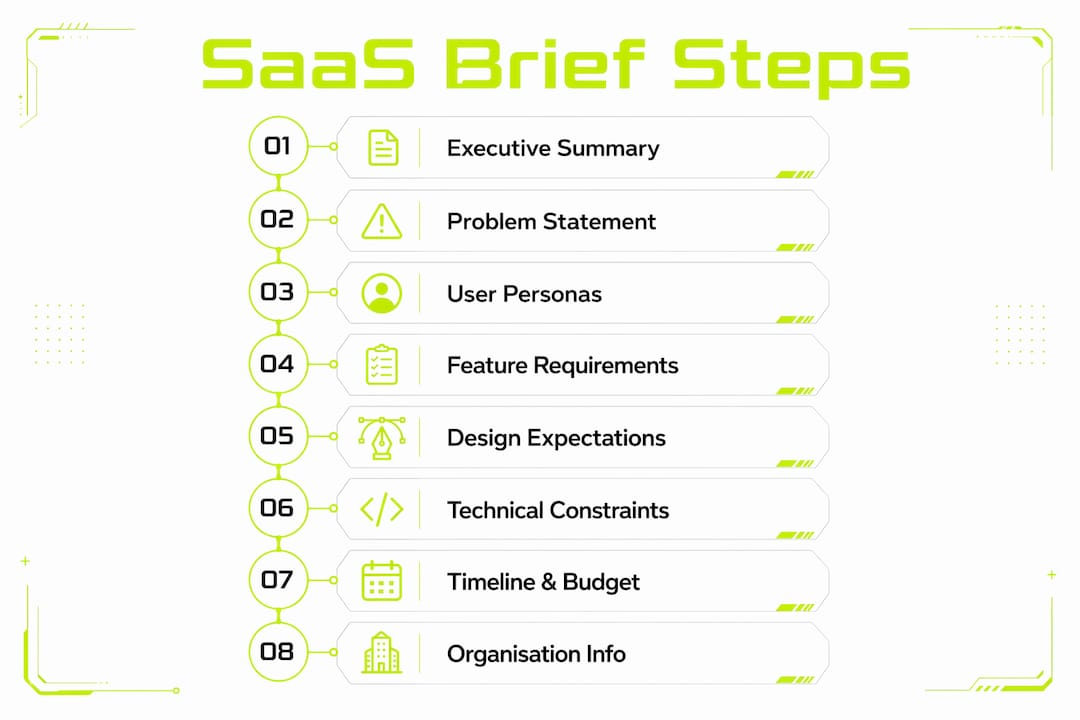
Feature requirements with prioritisation
List every feature you want, then label each one. A simple two-tier system works well:
- Must Have: the product cannot launch without this feature
- Nice to Have: adds value but is not required for the first release
For each Must Have feature, write an acceptance criterion. This is a plain-English statement of what “done” looks like. For example: “A user can reset their password via email within 60 seconds.” Common briefing mistakes include confusing features with outcomes and leaving acceptance criteria out entirely. Features without acceptance criteria are guesses dressed up as requirements.
User flows
A user flow is a numbered sequence of steps a user takes to complete a task. Write one for each critical feature. For example:
- User lands on the login page
- User enters email and password
- System validates credentials
- User is redirected to their dashboard
These flows expose logic gaps before development begins. They are far more useful to a developer than a wireframe alone.
Design and UX expectations
Specify whether you have brand guidelines, a preferred design system such as Material Design or Tailwind UI, or accessibility requirements such as WCAG 2.1 AA compliance. Design files alone cannot substitute for written logic. Figma shows how something looks. It does not show how it behaves.
Technical constraints and preferences
Note any hosting preferences (AWS, Google Cloud, or a specific UK data centre for GDPR compliance), preferred tech stack, or third-party integrations. If you have no preference, say so. Forcing a tech stack without rationale creates friction.
Timeline and budget
Give a realistic range for both. A clear budget range helps agencies provide accurate estimates and reduces the risk of scope misunderstanding. You do not need an exact figure. A range such as “£20,000 to £35,000 for an MVP” is enough to filter out mismatched proposals.
About you and your organisation
Tell the developer who they will be working with, how you prefer to communicate (Slack, email, weekly calls), and who makes decisions. This section prevents weeks of confusion about approvals and feedback loops.
How to prepare and organise your brief before sharing it
Preparation separates a brief that gets a sharp, accurate proposal from one that generates a wall of clarifying questions. The goal is to give enough detail for a developer to estimate confidently, while leaving room for a discovery phase to resolve the finer points.
Start by gathering your business context. Write down your revenue model, your target market, and any regulatory requirements your platform must meet. Then document your technical constraints honestly. If you are on a tight budget or need UK data residency, say so upfront.
Prioritise your features realistically. Most founders overestimate what belongs in version one. A useful exercise is to ask: “If this feature were missing at launch, would users still get value?” If the answer is yes, move it to the Nice to Have list.
Avoid these common preparation traps:
- Writing vague functional descriptions such as “users can manage their account” without specifying what “manage” means
- Demanding a specific tech stack without explaining why
- Sharing only a prototype or mockup and expecting the developer to infer the logic
- Leaving success criteria undefined, so neither party knows when a feature is complete
Pro Tip: Create a one-page summary table listing each Must Have feature, its acceptance criterion, and its estimated complexity (Low, Medium, High). This single table saves hours of back-and-forth during estimation.
Use a shared document tool such as Notion or Google Docs so the brief can be updated and versioned. A brief is a living document. It should evolve as your thinking sharpens, not sit in a PDF that nobody can edit.
How to onboard a developer effectively once you have your brief
Onboarding a developer for SaaS is where many founders lose momentum. A strong brief gets you a great proposal. Poor onboarding wastes the first two weeks of the build.
Follow these steps to get a developer productive from day one:
- Prepare access in advance. Set up credentials for your project management tool, staging environment, and any third-party services before the developer starts. Waiting until day one to sort access wastes billable time.
- Share onboarding documentation. Provide a README or setup guide covering environment configuration, coding standards, and deployment process. Elite SaaS teams onboard developers to running the project locally and making real code commits within 1–4 hours from first access.
- Assign a meaningful first ticket. The first task given to a new developer should be a real, completable piece of work achievable in 2–3 days, not exploratory setup work. A small but genuine feature or a clearly scoped bug fix builds momentum and confidence.
- Set up communication channels clearly. Agree on one primary channel for daily communication and one for urgent issues. Ambiguity here leads to missed messages and delayed decisions.
- Schedule an early check-in. A 30-minute call at the end of day one or two surfaces misunderstandings before they become expensive. Ask the developer to summarise their understanding of the first sprint goal in their own words.
Pro Tip: Write a one-page “project context” document separate from the brief. Include the business model, the target user in plain language, and the three things that matter most at launch. Give this to every new developer on day one.
Developers prioritise clear documentation and speed to first meaningful output over lengthy demos or hand-holding sessions. The faster you remove blockers, the faster the build moves. You can find more on structuring this process in this guide to hiring a developer for custom projects.
What are common pitfalls in briefing and how do you fix them?
Even a well-intentioned brief can create problems if certain patterns go unchecked. Recognising these pitfalls early keeps your project on track.
Misaligned scope expectations are the most common issue. A founder describes a feature in one sentence. The developer builds a version that solves a different interpretation of the same sentence. The fix is acceptance criteria. Every Must Have feature needs a written, testable definition of done.
Feature creep happens when new ideas are added mid-sprint without removing something else. Agree with your developer upfront that any new feature request triggers a scope conversation, not an automatic addition to the current sprint.
Assumptions without documentation are silent killers. Developers fill information gaps with assumptions. Those assumptions are rarely wrong through carelessness. They are wrong because the founder never wrote down the correct answer. Version-control your brief so both parties can see what changed and when.
“A brief is not a legal contract. It is a shared understanding. The goal is to make the developer’s assumptions match your intentions before the build begins.”
When the brief itself is unclear and cannot be resolved through conversation, the right move is a paid discovery phase. A discovery phase lasting 2–4 weeks, costing between $5,000 and $15,000, is an industry best practice for clarifying scope and producing a high-fidelity project roadmap. It is not an extra cost. It is insurance against a failed build.
Common fixes for briefing problems include:
- Rewriting vague feature descriptions as user stories: “As a [user type], I want to [action] so that [outcome]”
- Adding edge cases to user flows (what happens when a user enters invalid data?)
- Scheduling a weekly brief review for the first month to catch drift early
- Using a shared changelog to track every update to the brief
Key takeaways
A well-written SaaS development brief, combined with structured onboarding, is the most reliable way to keep a build on time, on budget, and aligned with your original vision.
| Point | Details |
|---|---|
| Write acceptance criteria for every feature | Plain-English success conditions prevent misinterpretation and scope disputes. |
| Use a discovery phase for complex builds | A 2–4 week discovery phase produces a reliable roadmap and reduces build risk. |
| Prepare developer access before day one | Credentials and environment setup in advance prevent wasted time at the start. |
| Assign a real first task within 2–3 days | A meaningful early ticket builds momentum and confirms the developer understands the brief. |
| Treat the brief as a living document | Version-control updates so both parties share the same current understanding. |
What I have learned from briefing conversations with founders
After more than 20 years building custom software, the pattern I see most often is not a lack of ideas. Founders have plenty of those. The gap is between a founder’s mental model of their product and the written document a developer actually needs to build it.
The briefs that lead to the smoothest builds share one quality: they describe outcomes, not interfaces. A founder who writes “users need to see their subscription status at a glance” gives a developer room to build the right thing. A founder who writes “put a green badge in the top right corner” has made a design decision before the logic is even defined. That order of operations causes problems.
I have also seen founders treat the brief as a one-time deliverable, handed over and forgotten. The best briefs I have worked from were updated weekly during the early sprints. New information always surfaces once building starts. A brief that cannot absorb that information becomes a liability.
The other thing worth saying plainly: investing two or three days in a proper brief before you engage a developer is not slow. It is the fastest path to a working product. Every hour spent clarifying requirements upfront saves three to five hours of rework later. That ratio holds whether you are building a simple SaaS tool or a multi-tenant platform. The developer’s role in a startup is to solve problems with code. Your job is to make sure they are solving the right ones.
— Richard
Working with Richharrington on your SaaS build
Richharrington builds custom SaaS platforms for founders who want a direct line to a senior engineer, not a project manager relaying messages to an offshore team.
If you have a brief ready or are still pulling your requirements together, Richharrington can help you structure your thinking, identify gaps, and move from document to working product without the usual back-and-forth. Every build starts with a clear conversation about what you need and why. Take a look at the custom SaaS development service to see how the process works, or get in touch directly to talk through your project.
FAQ
What should a SaaS development brief include?
A SaaS development brief should include an executive summary, a problem statement, target user personas, prioritised feature requirements with acceptance criteria, user flows, design expectations, technical constraints, and a budget range. These elements give a developer everything needed to estimate and plan accurately.
How long should a SaaS development brief be?
A brief for an MVP SaaS product typically runs between five and fifteen pages. Length matters less than clarity. A concise, well-structured ten-page brief outperforms a vague thirty-page document every time.
What is a discovery phase and do I need one?
A discovery phase is a paid, time-limited engagement (typically 2–4 weeks) where a developer or agency works with you to clarify scope, map user flows, and produce a detailed project roadmap. It is worth commissioning when your requirements are complex or when early quotes vary widely.
Why do design files not replace a written brief?
Design files show how a product looks. They do not communicate business logic, edge cases, or acceptance criteria. Written briefs describing user flows and logic are what developers need to build the right behaviour, not just the right appearance.
How quickly should a developer be productive after onboarding?
A well-onboarded developer should be running the project locally and making real commits within 1–4 hours of first access. The first meaningful task should be completable within 2–3 days. If onboarding takes longer than that, the setup process needs simplifying.